

Do Dental Implants Last Forever? Lifespan & Failure Explained
Quick Answer
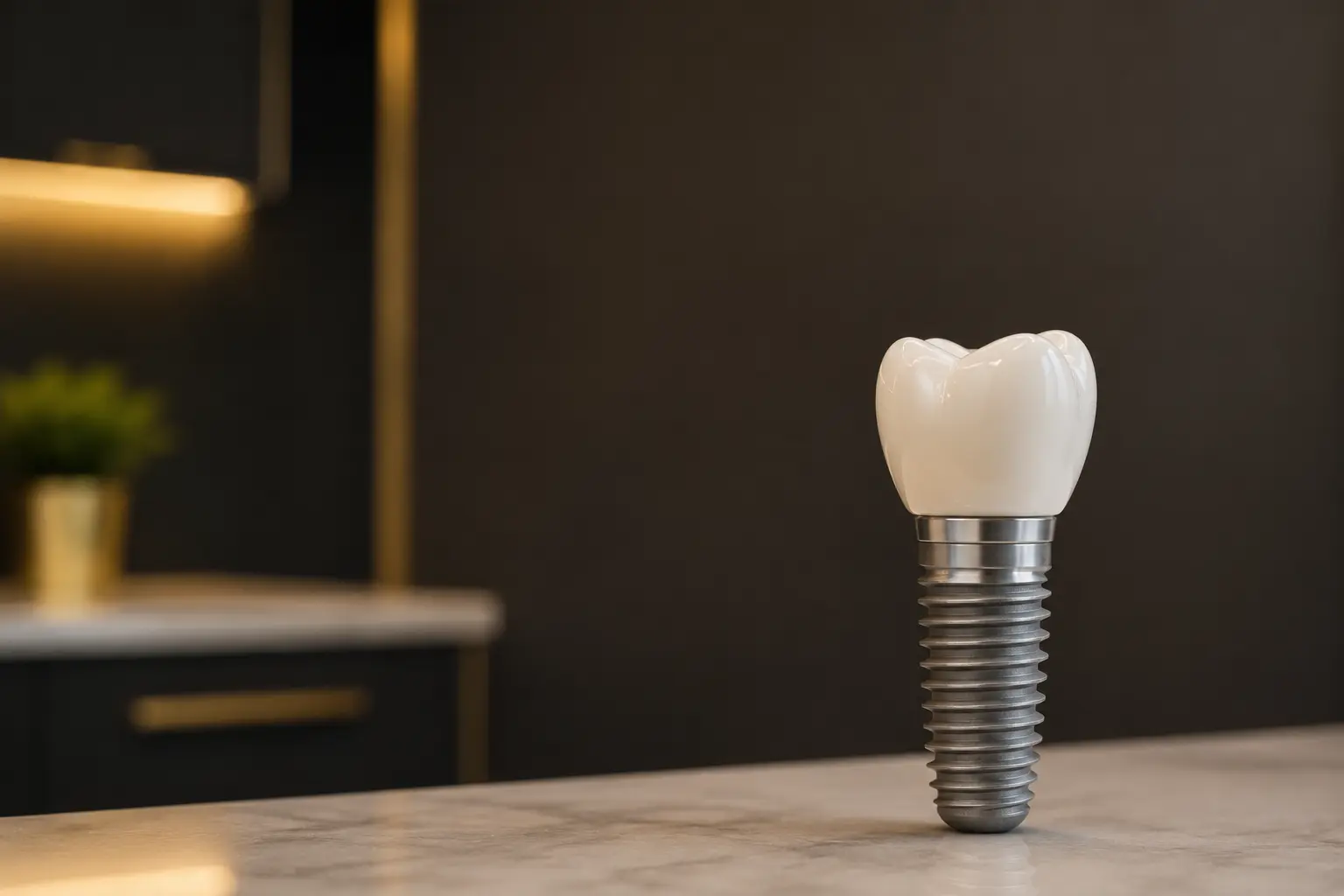
The titanium implant itself can last a lifetime — more than 95% of implants are still working after 10 years, and many last 20 to 30 years or more. What usually wears out first is the crown on top, which typically needs replacing after about 10–20 years. Implants do not get cavities, but they can fail if the gum and bone around them become infected (peri-implantitis), so good hygiene and regular check-ups are what make them last.
"Do dental implants last forever?" is one of the most common questions patients ask before committing to treatment — and it is a fair one, given the investment involved. The honest answer is encouraging: implants are by far the most durable tooth-replacement option available, and for many people the implant itself never needs replacing. But "lasting" depends on a few things within your control. This guide, written by a practising dentist, explains how long implants really last, which part wears out first, why implants fail, and exactly what you can do to keep yours for decades — for patients across Chandigarh, Mohali, Panchkula and Zirakpur.
Key Takeaways
- The implant post can last a lifetime — over 95% are still functioning after 10 years.
- The crown on top lasts around 10–20 years and may then need replacing due to normal wear.
- Implants cannot get cavities, but the gum and bone around them can still get infected.
- Peri-implantitis (gum infection around the implant) is the leading cause of late failure.
- Smoking, poor hygiene, uncontrolled diabetes and teeth grinding are the biggest risks.
- Good daily care and regular dental visits are what make an implant last for decades.
How Long Do Dental Implants Actually Last?
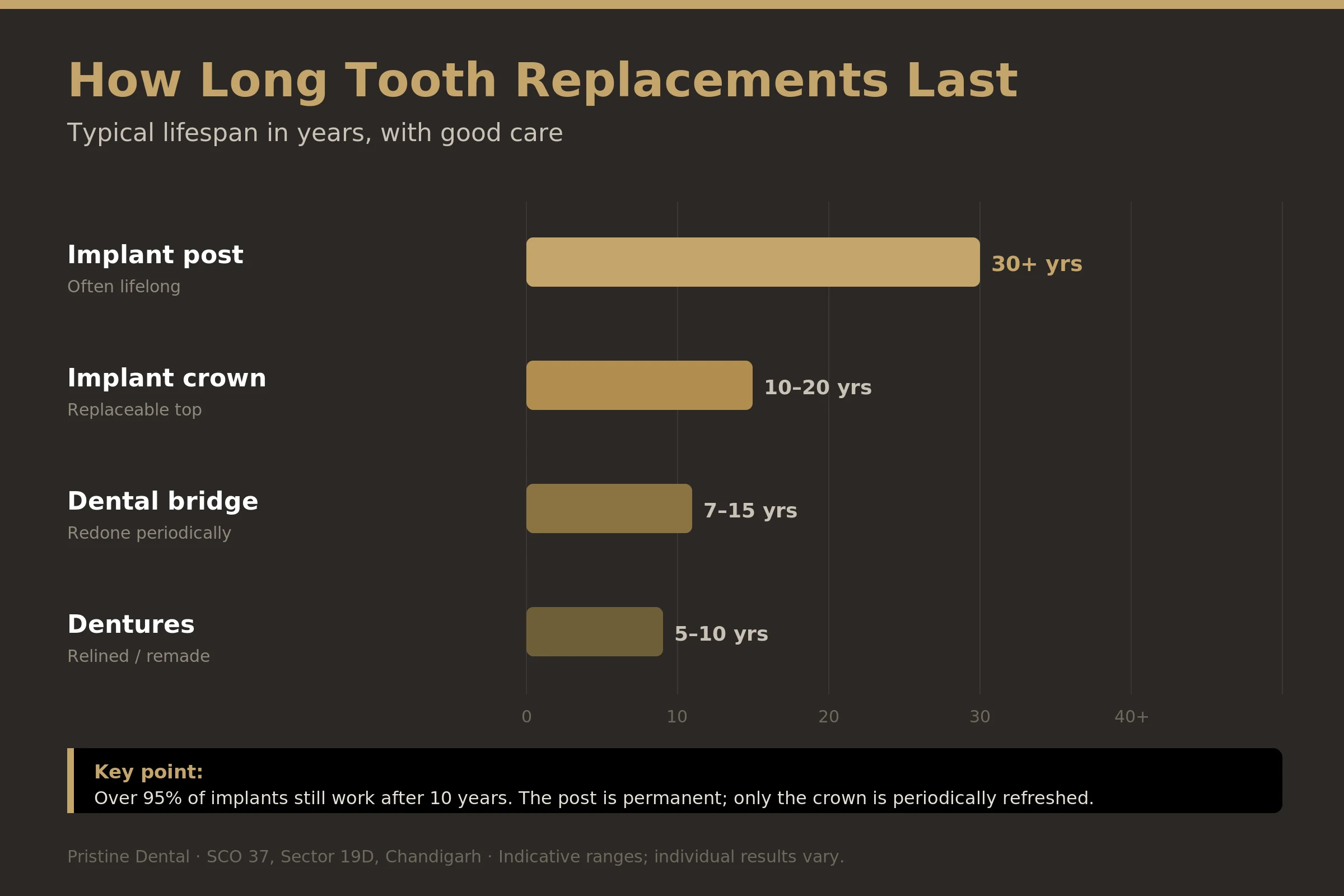
Most dental implants last between 15 and 25 years, and the implant post itself often lasts a lifetime. Long-term studies consistently show survival rates above 95% at 10 years, and a large share of implants are still going strong well beyond 20 years. In other words, once an implant has successfully fused to your jawbone, it is designed to be a permanent replacement.
It helps to think of a dental implant as having two parts with two different lifespans: the titanium post inside the bone, and the visible crown on top. The post is the long-term foundation; the crown is the part that takes the daily wear of biting and chewing.
What Do the Success-Rate Numbers Actually Mean?
When dentists say implants have a "95% success rate at 10 years," it means that out of 100 implants placed, about 95 are still healthy and functioning a decade later. That is one of the highest success rates of any procedure in medicine or dentistry. Just as importantly, these numbers keep improving as planning technology, implant surfaces and surgical techniques advance.
It is worth understanding what those figures do and do not promise. A high success rate reflects implants placed in suitable patients and cared for properly — it is not a guarantee that ignores smoking, gum disease or missed check-ups. Think of the percentage as the strong starting odds; your daily habits and follow-up care are what push your own implant towards the top of that range. In practice, a healthy non-smoker who cleans well and attends regular reviews can reasonably expect their implant to last far longer than the average.
Which Part Wears Out First: The Post or the Crown?
The crown almost always needs attention long before the implant post does. This is completely normal and expected — the crown is a working surface, and years of chewing gradually wear it down.
| Component | Typical Lifespan | Why |
|---|---|---|
| Titanium implant post | 20–30+ years, often lifelong | Fuses with bone; not exposed to wear or decay |
| Abutment (connector) | Very long-lasting | Protected inside; rarely needs changing |
| Crown (visible tooth) | 10–20 years | Takes daily biting force and normal wear |
So if a dentist ever tells you your implant "needs work" after 15 years, it usually means replacing the crown — a straightforward procedure — not removing the implant itself. Compared with a crown and bridge or dentures, which typically need redoing sooner, the implant foundation is remarkably durable.
Does the Implant Material Affect How Long It Lasts?
Most implants are made of titanium, which has decades of proven durability, while newer zirconia (ceramic) implants offer a metal-free alternative. Both are biocompatible — meaning the body accepts them well — and both can last many years when placed and maintained properly.
Titanium remains the gold standard: it is exceptionally strong, integrates reliably with bone, and has the longest track record, with implants documented to last several decades. Zirconia is a good option for patients who prefer a metal-free solution or have thin gums where a white implant material is less likely to show through, though its long-term data is still growing. For the vast majority of patients, the choice of a reputable, quality implant system by an experienced dentist matters far more to longevity than the specific material. Cheap, unbranded implants are a false economy — the small saving is rarely worth the higher risk over the years.
Why Do Dental Implants Fail?
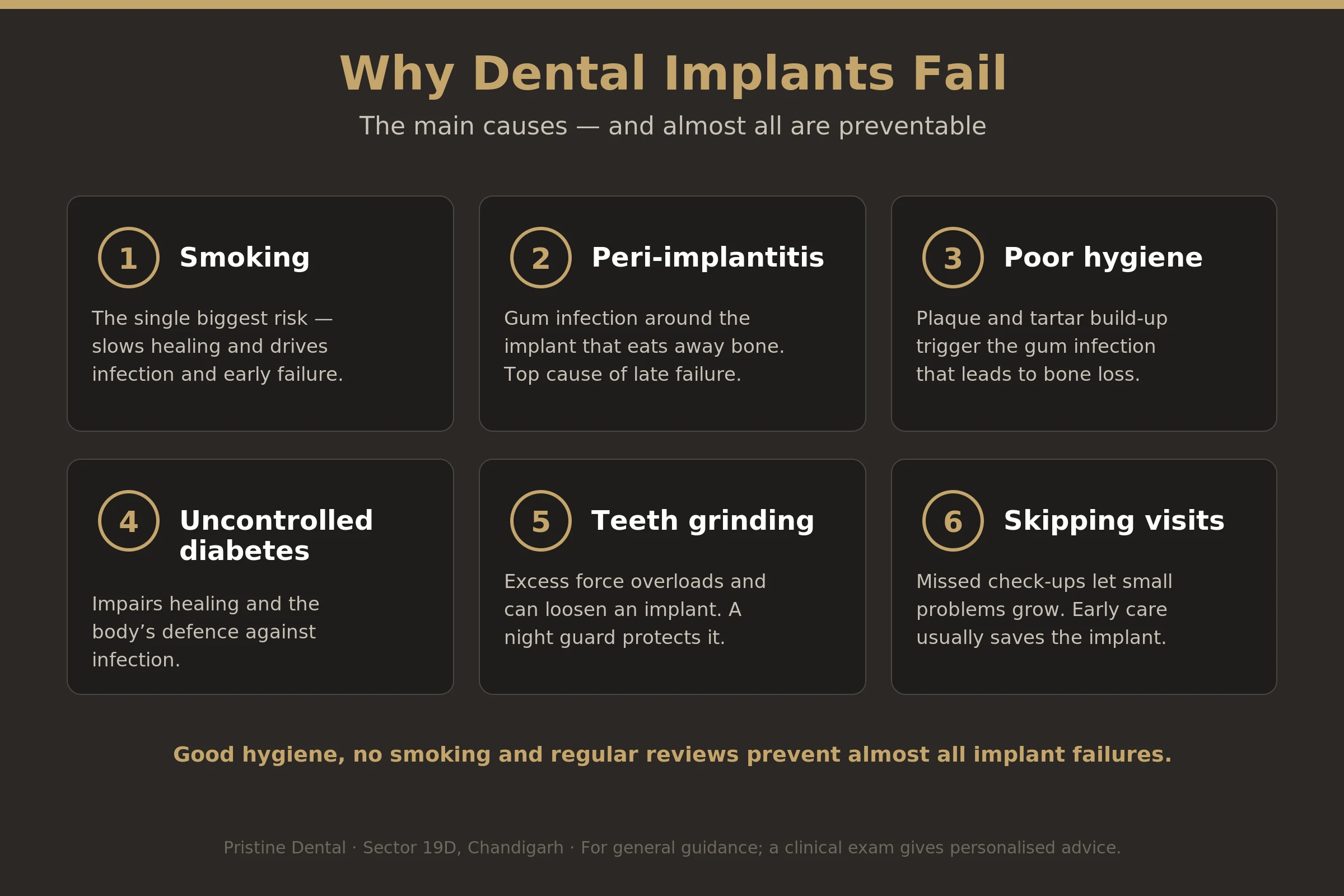
Implant failure is uncommon, but when it happens it is almost always due to infection, bone loss, or lifestyle and health factors — not the implant "wearing out." Failures fall into two types depending on when they occur.
Early failure (within the first year)
This happens when the implant does not fuse properly with the bone. Common reasons include smoking, uncontrolled diabetes, insufficient bone, or infection during healing. Early failure is relatively rare and is usually detected quickly.
Late failure (after years of use)
The leading cause of late failure is peri-implantitis — a gum infection around the implant that gradually destroys the supporting bone. It is essentially gum disease around an implant, driven by plaque and tartar build-up, and it is why ongoing hygiene matters just as much after treatment as before.
The Biggest Risk Factors for Implant Failure
Most implant failures are linked to a handful of well-known risk factors — and most of them are within your control.
- Smoking — the single biggest risk, slowing healing and greatly increasing failure and infection rates.
- Poor oral hygiene — allows plaque and tartar to build up and trigger peri-implantitis.
- Uncontrolled diabetes — impairs healing and the body's ability to fight infection.
- Untreated gum disease — existing infection puts nearby implants at risk.
- Teeth grinding (bruxism) — excessive force can overload and loosen an implant over time.
- Skipping dental check-ups — problems that could be caught early are missed.
The good news
Almost every one of these risks is preventable or manageable. Stopping smoking, keeping your gums healthy, and seeing your dentist regularly dramatically improve the odds that your implant lasts for life.
How to Make Your Dental Implant Last Longer
An implant will reward good care with decades of service. The habits that protect it are simple and no different from looking after healthy natural teeth.
- Brush twice a day and clean between your teeth daily, using floss or interdental brushes around the implant.
- Keep regular dental check-ups and professional cleanings — a scaling and polishing visit removes tartar your brush cannot.
- Do not smoke — quitting is the single best thing you can do for implant survival.
- Wear a night guard if you grind your teeth, to protect the crown and implant from excessive force.
- Manage conditions like diabetes and keep your general health in good shape.
- Report any warning signs early — bleeding, swelling, looseness or discomfort around the implant.
Signs Your Implant Needs Attention
A healthy implant should feel stable, painless and just like a natural tooth. See your dentist promptly if you notice any of the following:
- Gums around the implant that are red, swollen or bleed easily.
- Any looseness or movement of the crown or implant.
- Persistent discomfort, tenderness or pain when biting.
- Gum receding around the implant, or a bad taste or smell.
Caught early, most implant problems — including early peri-implantitis — can be treated and the implant saved. This is exactly why regular reviews matter.
Are Implants Still Worth It If the Crown Needs Replacing?
Yes — even accounting for an occasional crown replacement, implants are the most cost-effective long-term tooth replacement. A tooth-replacement option like a bridge or dentures often needs redoing every 7–15 years, and a bridge relies on grinding down the healthy teeth beside the gap. An implant stands on its own, protects the jawbone, and its foundation typically never needs replacing. Over a lifetime, that durability usually makes it the better value as well as the more comfortable choice.
Common Myths About Implant Lifespan
A lot of the worry around implants comes from myths rather than facts. Here are a few worth clearing up:
- "Implants only last about 5 years." False — the post commonly lasts 20–30 years or more; it is the crown that may be refreshed sooner.
- "Once you have an implant you don't need the dentist." The opposite is true — regular reviews and cleanings are exactly what keep it healthy.
- "Implants get cavities like real teeth." They cannot decay, but the surrounding gum and bone still need protecting from infection.
- "If an implant fails, that's the end." A failed implant can usually be replaced once the site heals, often successfully.
- "The body always rejects some implants." True rejection is extremely rare; failures are due to infection or healing issues, not rejection.
Why Choose Pristine Dental for Dental Implants in Chandigarh

Pristine Dental is a modern, ethics-first practice at SCO 37, First Floor, Sector 19D, Chandigarh, caring for patients across Chandigarh, Mohali, Panchkula, Zirakpur, Kharar, New Chandigarh and the wider Tricity. We plan implants for the long term — not just to place them, but to help them last.
- Careful case planning — we assess bone, gums and health to maximise long-term success.
- Guided, precise placement for strong, stable integration.
- Structured maintenance and reviews to catch any issue early and protect your investment.
- Honest advice on risk factors like smoking, gum health and grinding.
- Open seven days a week, convenient for the whole Tricity.
Frequently Asked Questions
Do dental implants last forever?
The titanium implant post can last a lifetime, and over 95% are still working after 10 years. The crown on top usually needs replacing after about 10–20 years due to normal wear, but the implant foundation itself often never needs replacing.
How long do dental implants last on average?
Most implants last 15 to 25 years, and many last far longer with good care. Survival rates stay above 95% at 10 years in long-term studies.
What is the most common reason implants fail?
Late failures are most often caused by peri-implantitis, a gum infection around the implant that destroys the supporting bone. Early failures are usually due to smoking, poor healing or infection.
Can dental implants get cavities?
No. Implants and crowns are made of materials that cannot decay. However, the gums and bone around them can still become infected, so daily cleaning and check-ups remain essential.
How often does the crown need replacing?
The visible crown typically lasts 10 to 20 years before wear, chipping or a change in fit means it is worth replacing. Replacing a crown is straightforward and does not involve removing the implant.
Does smoking affect how long an implant lasts?
Yes, significantly. Smoking slows healing and greatly increases the risk of both early failure and long-term infection. Quitting is the single best thing you can do to help an implant last.
Can a failed implant be replaced?
In most cases, yes. Once the site has healed and any infection is treated, a new implant can often be placed. Your dentist will assess the bone and plan the best approach.
Do implants last longer than bridges or dentures?
Yes. Bridges and dentures usually need redoing every 7 to 15 years, while the implant post often lasts a lifetime. This durability makes implants the most cost-effective option over time.
Will my body reject a dental implant?
True rejection is extremely rare because titanium is biocompatible. When implants fail it is due to infection or poor integration, not an allergic rejection like an organ transplant.
What happens if I grind my teeth?
Grinding (bruxism) puts extra force on the implant and crown and can shorten their life. A custom night guard protects both, so tell your dentist if you grind or clench.
How do I know if my implant is failing?
Watch for red or swollen gums, bleeding, looseness, receding gums, a bad taste, or pain when biting. Seeing your dentist early usually means the implant can be saved.
Do I still need to see the dentist after getting an implant?
Absolutely. Regular check-ups and professional cleanings are what keep the gum and bone around your implant healthy, and they let problems be caught and treated early.
When to See a Dentist
Whether you are considering an implant or already have one, a dental review is the best way to protect your long-term result. If you are missing a tooth, a dentist can assess whether an implant suits your bone and gum health and explain what to expect over the years. If you already have an implant and notice any bleeding, swelling, looseness or discomfort, see a dentist promptly — early treatment is what saves implants. A quick consultation gives you clear, personalised answers.
Conclusion
So, do dental implants last forever? The foundation very often does — the titanium post is designed to be permanent, and with good care it frequently lasts a lifetime. The crown on top will likely need refreshing once or twice over the decades, which is normal and simple. What truly determines an implant's lifespan is not the hardware but the care around it: healthy gums, good daily hygiene, no smoking, and regular dental visits. Look after an implant the way you would a healthy natural tooth, and it can serve you comfortably for the rest of your life.
Thinking about implants that last?
Book a consultation at Pristine Dental, SCO 37, First Floor, Sector 19D, Chandigarh. We'll assess your suitability, explain the long-term care honestly, and help you get a tooth replacement built to last. Serving Chandigarh, Mohali, Panchkula, Zirakpur and the wider Tricity.
Book Your Implant Consultation
Periodontist & implantologist with 14+ years' experience at Pristine Dental, Sector 19D, Chandigarh. Reviews clinical content for accuracy.