

TMJ Disorder: Symptoms, Causes & When to See a Dentist

Quick Answer
A TMJ disorder (TMD) is a problem with the jaw joint and the muscles that move it, causing symptoms like jaw pain, clicking or popping, headaches, earaches and difficulty chewing. It is common — affecting at least 1 in 10 adults — and is most often caused by teeth grinding or clenching, stress, bite problems or jaw injury. The good news: the large majority of cases improve with simple, non-surgical care such as a night guard, jaw rest and habit changes. See a dentist if jaw pain, locking or clicking with discomfort lasts more than a week or two.
That click when you open your mouth, the dull ache near your ear, the headaches that start at the temples — these are some of the most common and most misunderstood complaints a dentist sees. They often point to a TMJ disorder, a treatable problem with the jaw joint that many people live with for years without realising a dentist can help. This guide, written by a practising dentist, explains what a TMJ disorder is, its symptoms and causes, what you can do at home, and exactly when to seek help — for patients across Chandigarh, Mohali, Panchkula and Zirakpur.
Key Takeaways
- TMD affects the jaw joint and muscles, causing pain, clicking, and restricted movement.
- It is very common — at least 12% of adults experience it, and more women than men.
- Teeth grinding and clenching are leading causes, often linked to stress.
- Most cases are mild and improve with simple, non-surgical care.
- A custom night guard is the most common treatment and protects your teeth too.
- Surgery is rarely needed — it is reserved for severe, unresponsive cases.
What Is a TMJ Disorder?
The temporomandibular joint (TMJ) is the hinge that connects your lower jaw to your skull, just in front of each ear. You have one on each side, and they work every time you talk, chew, yawn or swallow — thousands of times a day. A TMJ disorder, or TMD, is any problem affecting these joints or the muscles that control them.
Because the joint, muscles, nerves and teeth all work together, a problem in one area can create symptoms that seem unrelated — which is why TMD is often mistaken for an ear infection, a migraine or ordinary toothache. Understanding that these can share a single root cause is the first step to getting the right treatment.
Common Symptoms of TMJ Disorder
TMD symptoms range from a mild, occasional click to constant pain that affects daily life. You may have just one of these signs or several at once.
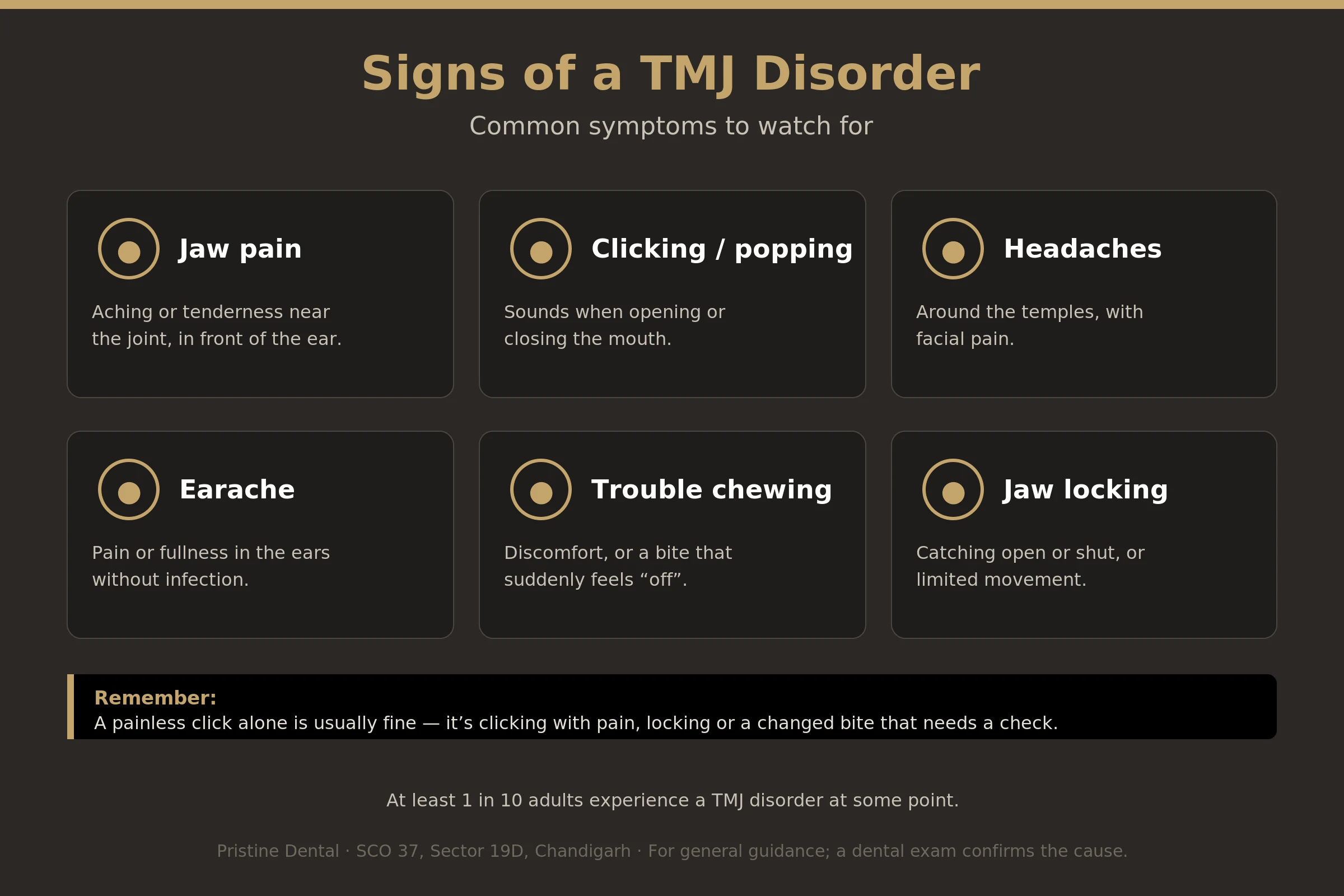
- Jaw pain or tenderness, especially near the joint in front of the ear.
- Clicking, popping or grating sounds when you open or close your mouth.
- Headaches, often around the temples, and facial pain.
- Earache or a feeling of fullness in the ears, without infection.
- Difficulty or discomfort chewing, or a bite that suddenly feels "off".
- Jaw locking or limited movement — the jaw catching open or shut.
- Pain spreading to the neck and shoulders.
- Worn, sensitive or cracked teeth from associated grinding.
Clicking without pain?
A painless click on its own is usually not urgent. It becomes worth checking when the clicking comes with pain, muscle soreness, locking, reduced movement, or a bite that feels different.
What Causes TMJ Disorders?
TMD usually results from a combination of factors rather than a single cause — most commonly muscle tension, joint strain and inflammation working together. The main contributors are:
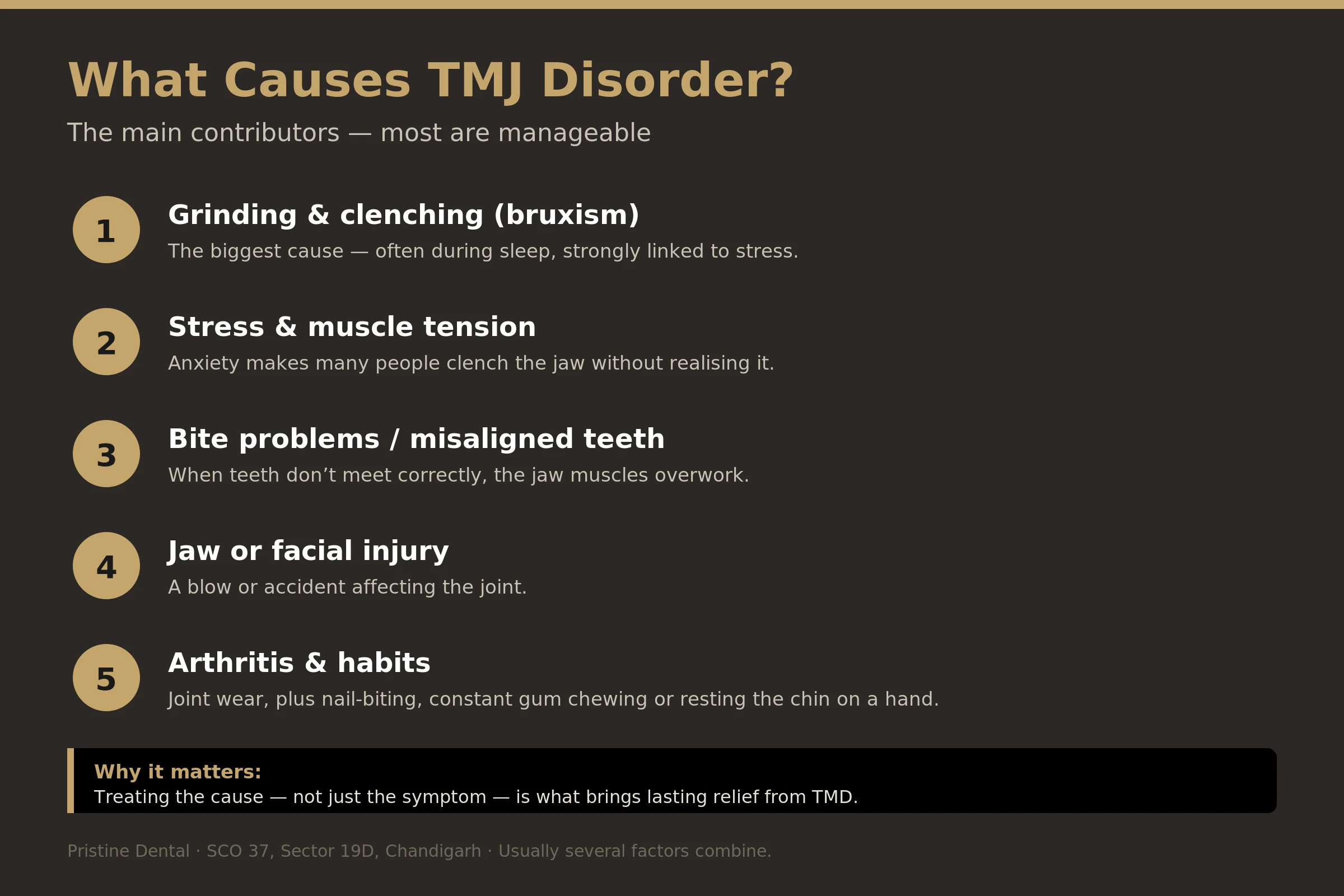
- Teeth grinding and clenching (bruxism) — the biggest culprit, often happening during sleep and strongly linked to stress.
- Stress and muscle tension — anxiety makes many people clench their jaw without realising it.
- Bite problems or misaligned teeth — when teeth do not meet correctly, the jaw muscles overwork.
- Jaw or facial injury — a blow or accident affecting the joint.
- Arthritis in the joint, which can wear down its smooth surfaces.
- Habits like nail-biting, chewing gum constantly, or resting the chin on the hand.
Identifying which of these applies to you is central to treatment — because fixing the cause, not just the symptom, is what brings lasting relief.
How Is TMJ Disorder Diagnosed?
A dentist diagnoses TMD through a careful examination of your jaw, bite and muscles, along with your symptom history. During the assessment, your dentist will feel the joints as you open and close, listen for clicking or grating, check how far your jaw moves, and examine your teeth for signs of grinding. In some cases an X-ray, or a scan such as a CBCT or MRI, is used to look at the joint in more detail. This is exactly the kind of assessment that separates a true TMJ problem from a simple toothache or ear issue, so the right treatment can begin.
Home Remedies and Self-Care for Jaw Pain
Many mild TMJ flare-ups settle with simple self-care over a few weeks. These steps ease the strain on your jaw while it recovers:
- Rest your jaw — eat soft foods and avoid wide yawns, hard or chewy items, and chewing gum.
- Apply warm or cold compresses to the jaw muscles to ease pain and relax them.
- Practise stress management — relaxation, breathing exercises and better sleep reduce clenching.
- Be aware of clenching — keep your teeth slightly apart during the day; lips together, teeth apart.
- Gentle jaw stretches as advised, to keep the joint mobile.
- Over-the-counter pain relief for short-term comfort during a flare-up.
If these measures do not help within a couple of weeks, or symptoms are getting worse, it is time to see a dentist rather than keep managing alone.
Professional TMJ Treatment Options
The great majority of TMJ disorders are treated successfully without surgery. Treatment is matched to the cause and severity of your symptoms.
| Treatment | What It Does | Best For |
|---|---|---|
| Custom night guard / splint | Cushions the bite and stops grinding damaging teeth and the joint | Grinding and clenching (most common) |
| Bite correction / orthodontics | Aligns how the teeth meet to reduce muscle strain | Bite problems or misaligned teeth |
| Physiotherapy & jaw exercises | Relaxes and strengthens the jaw muscles, improves movement | Muscle tension and stiffness |
| Stress management | Reduces the clenching that drives many cases | Stress-related TMD |
| Medication (short-term) | Eases pain and inflammation during flare-ups | Acute pain |
| Surgery (rare) | Repairs structural joint damage | Severe cases not responding to other care |
A custom night guard is the single most common treatment. Made to fit your teeth precisely, it holds the jaw in a comfortable position, relaxes the muscles and protects your teeth from grinding — often bringing noticeable relief within weeks.
What Happens If TMJ Disorder Is Left Untreated?
Most TMJ disorders are mild, but ignoring persistent symptoms can let a simple problem grow into a more stubborn one. When the underlying cause — usually grinding, clenching or a bite issue — continues unchecked, the ongoing strain can lead to several knock-on effects:
- Chronic jaw and facial pain that becomes harder to settle the longer it persists.
- Worn, cracked or sensitive teeth from continued grinding, sometimes needing crowns or other repairs.
- Frequent headaches and disturbed sleep, which affect concentration and daily wellbeing.
- Reduced jaw movement or more frequent locking, making eating and speaking uncomfortable.
- Neck and shoulder tension as the body compensates for the jaw.
None of this is meant to alarm you — it is simply why early, simple treatment is almost always easier and cheaper than waiting. Catching TMD early usually means a night guard and a few habit changes, rather than more involved care later.
Can TMJ Disorder Be Prevented?
You cannot prevent every case, but you can lower your risk and stop mild symptoms from getting worse with a few simple habits. Because grinding, clenching and stress drive so many cases, managing those makes the biggest difference:
- Manage stress through relaxation, exercise and good sleep — the single most useful step for most people.
- Notice and stop daytime clenching — keep your teeth apart and jaw relaxed unless eating.
- Wear a night guard if you grind in your sleep, to protect both the joint and your teeth.
- Avoid overworking the jaw — limit gum, very chewy foods, and biting nails or pens.
- Correct a problem bite — if misaligned teeth are straining your jaw, options like clear aligners or braces can help.
- Keep up regular dental check-ups so early signs of grinding or bite trouble are spotted.
When to See a Dentist
See a dentist if jaw pain, stiffness or clicking with discomfort lasts more than a week or two, or keeps coming back. You should book an appointment promptly if you notice:
- Ongoing jaw pain or tenderness that does not settle with self-care.
- Your jaw locking open or shut, or a clear drop in how wide you can open.
- Frequent headaches or facial pain with no other clear cause.
- Clicking or popping that comes with pain or muscle soreness.
- A bite that suddenly feels different, or worn and sensitive teeth.
Early assessment usually means simpler treatment. Left unaddressed, TMD can worsen and lead to chronic pain, damaged teeth and disturbed sleep, so it is worth getting checked rather than waiting it out.
Why Choose Pristine Dental in Chandigarh

Pristine Dental is a modern, ethics-first practice at SCO 37, First Floor, Sector 19D, Chandigarh, caring for patients across Chandigarh, Mohali, Panchkula, Zirakpur, Kharar, New Chandigarh and the wider Tricity. We look for the cause of your jaw and facial pain, not just the symptom, and start with the simplest effective treatment.
- Thorough jaw, bite and muscle assessment to pinpoint what is driving your TMD.
- Custom-made night guards and splints for grinding and clenching.
- Bite correction and orthodontic options when misalignment is the cause.
- Honest, conservative care first — surgery is rarely needed and never our starting point.
- Open seven days a week, convenient for the whole Tricity.
Frequently Asked Questions
What is a TMJ disorder?
A TMJ disorder (TMD) is a problem with the jaw joint and the muscles that move it. It causes symptoms like jaw pain, clicking or popping, headaches, earaches and difficulty chewing.
What are the main symptoms of TMJ?
Common signs include jaw pain or tenderness, clicking or popping when you open your mouth, headaches around the temples, earache, difficulty chewing, and the jaw locking or feeling stiff.
What causes TMJ disorders?
The most common cause is teeth grinding or clenching, often linked to stress. Bite problems, jaw injury, arthritis and certain habits can also contribute, and usually several factors combine.
Can TMJ disorder go away on its own?
Many mild cases settle with self-care such as jaw rest, soft foods and stress management over a few weeks. If symptoms last longer than a week or two or keep returning, see a dentist.
Is jaw clicking always a problem?
No. A painless click on its own is usually not urgent. It is worth checking when the clicking comes with pain, muscle soreness, locking, reduced movement or a bite that feels different.
How is TMJ disorder treated?
Most cases are treated without surgery, using a custom night guard, jaw rest and exercises, stress management, bite correction and short-term pain relief. A night guard is the most common treatment.
Does a night guard help with TMJ?
Yes. A custom night guard cushions the bite, relaxes the jaw muscles and stops grinding from damaging your teeth and joint. It is the most commonly prescribed TMD treatment and often brings relief within weeks.
Can stress cause jaw pain?
Yes. Stress and anxiety make many people clench or grind their teeth, often during sleep, which strains the jaw joint and muscles and is a leading cause of TMD.
Is TMJ surgery necessary?
Rarely. Surgery is reserved for severe cases with structural joint damage that do not respond to conservative treatment. The vast majority of patients improve with simple, non-surgical care.
Which doctor treats TMJ disorders?
Dentists are usually the first and best point of contact for TMD, as it involves the bite, teeth and jaw. Your dentist can diagnose it and provide or coordinate the right treatment.
Can TMJ cause headaches and earaches?
Yes. Because the jaw joint sits close to the ear and its muscles reach the temples, TMD often causes headaches, facial pain and a feeling of ear fullness or earache without infection.
How long does TMJ take to get better?
Mild cases often improve within a few weeks of self-care. With a night guard and professional treatment, many patients feel significant relief within one to three months, depending on the cause.
Conclusion
A TMJ disorder can be uncomfortable and disruptive, but it is common, well understood and highly treatable. Most people get better with simple, non-surgical steps — resting the jaw, managing stress, and wearing a custom night guard to control grinding. The key is not to ignore persistent jaw pain, clicking with discomfort, or locking, because early care is usually the simplest and most effective. If your jaw is telling you something is wrong, a dentist can find the cause and help you feel comfortable again.
Struggling with jaw pain or clicking?
Book a consultation at Pristine Dental, SCO 37, First Floor, Sector 19D, Chandigarh. We'll assess your jaw and bite, find the cause, and start with the simplest effective treatment — with no pressure. Serving Chandigarh, Mohali, Panchkula, Zirakpur and the wider Tricity.
Book Your TMJ Consultation
Periodontist & implantologist with 14+ years' experience at Pristine Dental, Sector 19D, Chandigarh. Reviews clinical content for accuracy.