

TMJ vs Migraine: How to Tell What's Causing Your Headache

Quick Answer
TMJ-related headaches usually start around the jaw, temples or ears and come with jaw clicking, tenderness or pain when chewing — while migraines are typically an intense, throbbing one-sided headache often with nausea and sensitivity to light and sound. The simplest clue: if your headache is linked to jaw movement, teeth grinding, or tenderness in front of your ears, a jaw (TMJ) cause is likely and a dentist can help. If it is a severe, pulsing headache with nausea or visual "aura", that points to migraine, which a doctor manages. The two can also overlap — and jaw problems can trigger or worsen headaches.
A headache around the temples, behind the eyes or near the ears can be confusing — is it a migraine, or is it coming from your jaw? The two are often mistaken for each other, and people can spend years treating one when the real cause is the other. This guide, written by a dentist who treats jaw and facial pain, explains the tell-tale differences between a TMJ (jaw-joint) problem and a migraine, how the two can overlap, and when to see a dentist versus a doctor — for patients across Chandigarh, Mohali, Panchkula, Zirakpur and the wider Tricity.
Key Takeaways
- TMJ pain is linked to the jaw — clicking, tenderness, and pain on chewing or opening wide.
- Migraine is a neurological condition — throbbing, often one-sided, with nausea and light/sound sensitivity.
- Location is a clue — TMJ pain centres on the jaw, temples and ears; migraine often sits behind or around one eye.
- They can overlap — jaw problems and teeth grinding can trigger or worsen headaches.
- A dentist handles TMJ; a doctor or neurologist manages migraine.
- The right diagnosis matters — it decides whether a night guard or a medical approach will actually help.
What Is TMJ?
"TMJ" refers to the temporomandibular joint — the hinge connecting your lower jaw to your skull, just in front of each ear. When this joint and the muscles around it are strained — often from teeth grinding, clenching, stress or a bite problem — it is called a TMJ disorder (TMD). It can cause jaw pain, clicking or locking, earache, facial tenderness and headaches, especially around the temples. To go deeper, see our guide to TMJ disorder symptoms and causes or our TMJ & jaw pain treatment page.
What Is a Migraine?
A migraine is a neurological condition, not a dental one — a specific type of headache that tends to be intense, throbbing and often on one side of the head. It commonly comes with nausea, sensitivity to light and sound, and sometimes visual disturbances called "aura" (flashing lights or blind spots) before the pain. Migraines are triggered by things like stress, certain foods, hormones, sleep changes and dehydration. They are managed medically, by a GP or neurologist, not by a dentist — although jaw issues can sometimes act as a trigger.
TMJ vs Migraine: The Key Differences
Although both can cause head pain, the surrounding clues usually point clearly to one or the other.
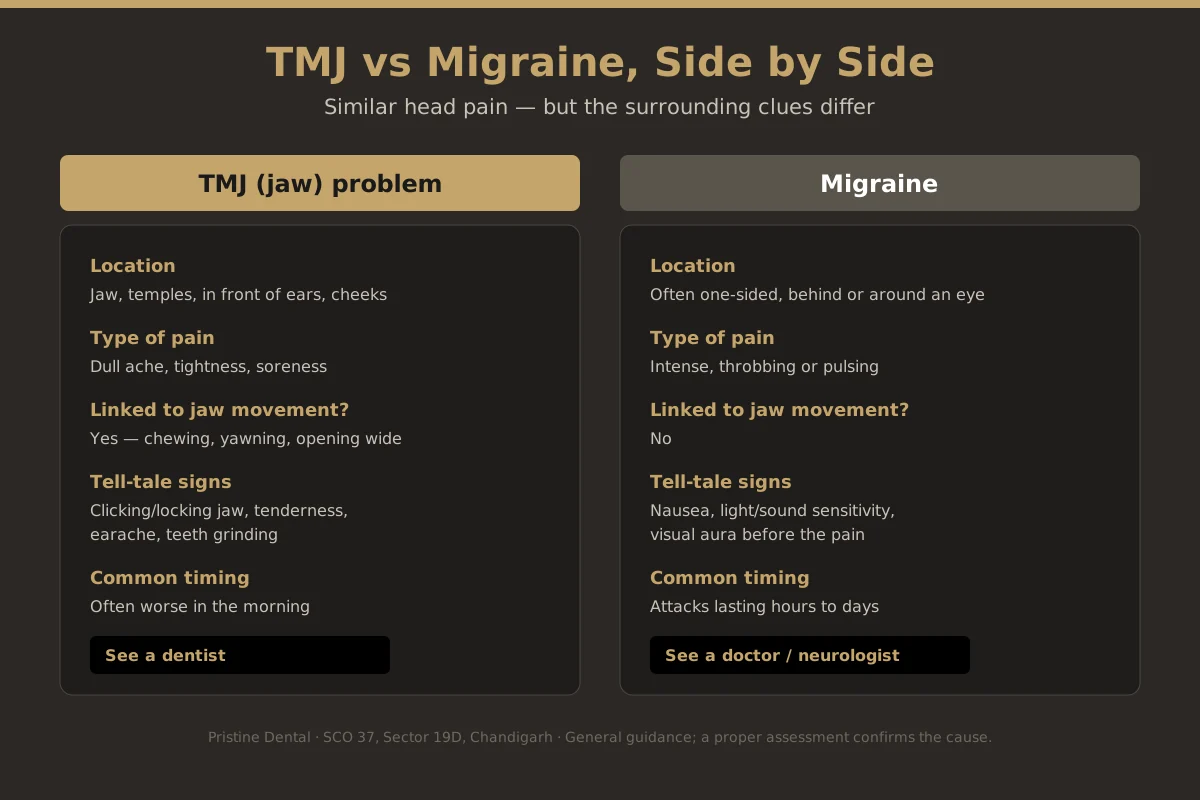
| Feature | TMJ (jaw) problem | Migraine |
|---|---|---|
| Main location | Jaw, temples, in front of the ears, cheeks | Often one-sided, behind or around an eye |
| Type of pain | Dull ache, tightness, soreness | Intense, throbbing or pulsing |
| Linked to jaw movement | Yes — chewing, yawning, opening wide | No |
| Tell-tale signs | Clicking/locking jaw, tenderness, earache, teeth grinding | Nausea, light/sound sensitivity, aura |
| Common timing | Often worse in the morning (night grinding) | Attacks lasting hours to days |
| Who treats it | Dentist | Doctor / neurologist |
How to Tell Which One You Have
Ask yourself what your pain is connected to. A few simple checks usually point the way:
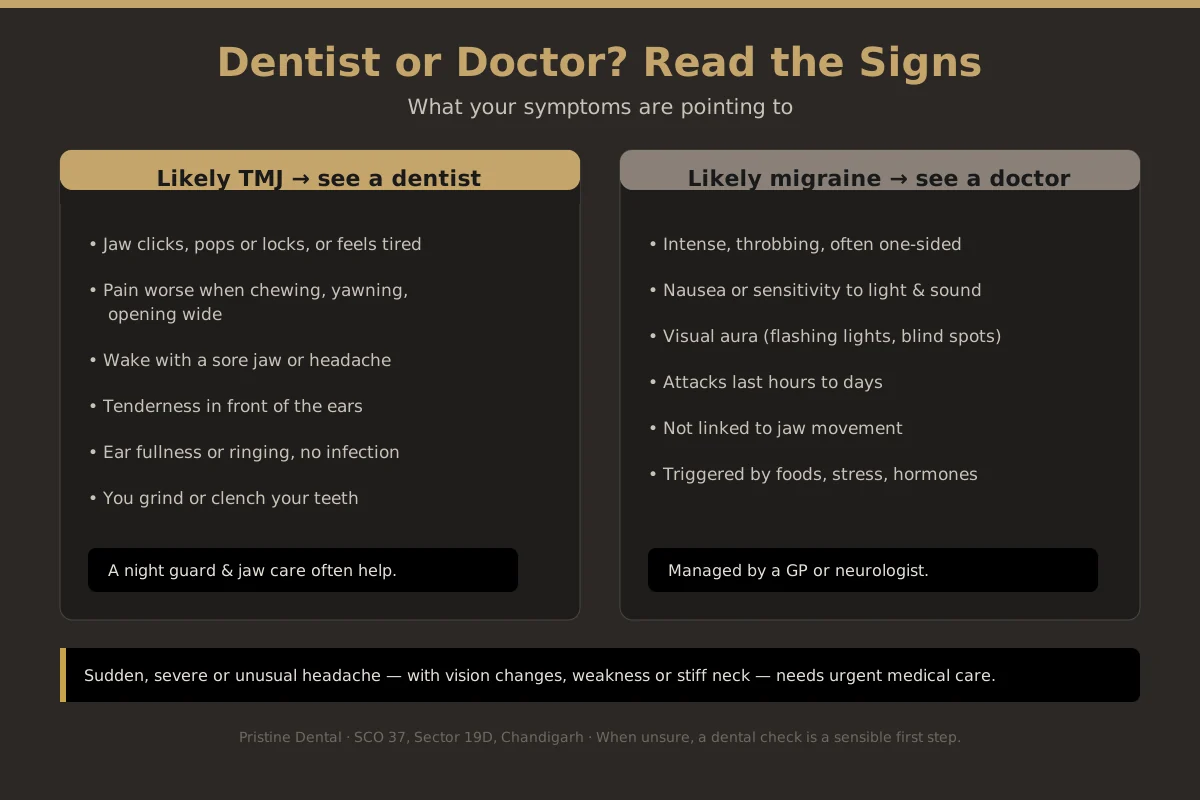
Signs it may be TMJ
- Your jaw clicks, pops or locks, or feels tired.
- Pain gets worse when you chew, yawn or open wide.
- You wake up with a sore jaw or headache (a sign of night-time grinding).
- You feel tenderness in front of your ears or in the cheek muscles.
- You notice ear fullness or ringing with no infection.
Signs it may be a migraine
- The pain is intense, throbbing and often one-sided.
- You feel nauseous or are sensitive to light and sound.
- You sometimes get visual aura (flashing lights, blind spots) beforehand.
- Attacks last hours to days and are not linked to jaw movement.
- Certain foods, stress or hormonal changes seem to set them off.
Can TMJ Cause or Trigger Headaches and Migraines?
Yes — a strained jaw joint and overworked chewing muscles can cause tension-type headaches and can act as a trigger that sets off or worsens migraines in people who are prone to them. Night-time clenching and grinding (bruxism) are common culprits, which is why many people wake with a headache. This overlap is exactly why the two are so often confused — and why some people get relief from headaches once their jaw problem is properly treated. It does not mean a dentist "cures" migraine, but reducing a jaw trigger can genuinely help.
Important
Severe, sudden or unusual headaches — especially with vision changes, weakness, confusion or a stiff neck — need urgent medical attention, not a dental opinion. When in doubt about a bad headache, see a doctor first.
When to See a Dentist vs a Doctor
Match the professional to the clues. If your pain is clearly tied to your jaw — clicking, grinding, tenderness, pain on chewing, morning headaches — start with a dentist, who can assess your jaw and bite and often help with a simple night guard or other TMJ treatment. If your pain fits the migraine pattern — throbbing, nausea, aura, light sensitivity — see your GP or a neurologist. If you are not sure, a dental assessment is a sensible, low-risk first step, because jaw causes are easy to check and often overlooked. You can read how we approach this in our guide to TMJ treatment in Chandigarh.
Why Choose Pristine Dental in Chandigarh

Pristine Dental is a modern, ethics-first practice at SCO 37, First Floor, Sector 19D, Chandigarh, caring for patients across Chandigarh, Mohali, Panchkula, Zirakpur, Kharar, New Chandigarh and the wider Tricity.
- Careful jaw & bite assessment to find out whether your pain is coming from the TMJ.
- Honest guidance — we tell you clearly if your symptoms point to migraine and you should see a doctor.
- Custom night guards and TMJ care for grinding, clenching and jaw pain.
- A conservative approach — simple, reversible treatments first.
- Open seven days a week, convenient for the whole Tricity.
Frequently Asked Questions
What is the difference between TMJ and migraine?
TMJ is a jaw-joint problem that causes pain around the jaw, temples and ears, usually with clicking or pain on chewing. A migraine is a neurological condition causing intense, throbbing, often one-sided headaches with nausea and light sensitivity. A dentist treats TMJ; a doctor manages migraine.
How do I know if my headache is from my jaw?
Clues that point to the jaw include clicking or locking, pain that worsens when you chew or yawn, waking with a sore jaw or headache, and tenderness in front of your ears. If your headache is linked to jaw movement or grinding, a TMJ cause is likely.
Can TMJ cause migraines?
A jaw problem can cause tension-type headaches and can trigger or worsen migraines in people prone to them, often through night-time clenching and grinding. Treating the jaw trigger can reduce these headaches, though it does not cure migraine itself.
Why do I wake up with a headache?
A common cause is night-time teeth grinding or clenching, which strains the jaw muscles and joint. This often produces a morning headache or sore jaw. A dentist can check for grinding and provide a night guard if needed.
Can a dentist help with my headaches?
If your headaches are caused or triggered by a jaw problem or teeth grinding, yes — a dentist can assess your jaw and bite and often help with a night guard or TMJ treatment. If your headaches are migraines unrelated to the jaw, a doctor is the right person.
Does a night guard help TMJ headaches?
For headaches linked to grinding and clenching, a custom night guard often reduces the strain on your jaw and can ease morning headaches and jaw pain. Your dentist will advise whether it suits your case.
Can you have both TMJ and migraines?
Yes. The two can exist together, and a jaw problem can make migraines more frequent. This overlap is why a careful assessment matters — sometimes both need attention, from a dentist and a doctor.
Is TMJ pain usually one-sided like a migraine?
TMJ pain can affect one or both sides, and it centres on the jaw, temples and ears. Migraine is more often one-sided and sits around or behind an eye. The associated signs — clicking versus nausea and aura — are usually the clearer clue.
When should I see a doctor urgently?
Seek urgent medical care for a sudden, severe or unusual headache, or one with vision changes, weakness, confusion, fever or a stiff neck. These need a doctor, not a dental opinion.
How is TMJ diagnosed?
A dentist examines your jaw joint, muscles and bite, checks how your jaw moves and where it is tender, and asks about grinding and symptoms. Imaging is used if needed. This identifies whether your pain is coming from the TMJ.
Should I see a dentist or doctor first?
If your symptoms clearly involve the jaw, start with a dentist. If they fit the migraine pattern, see a doctor. If you are unsure, a dental check is a sensible first step because jaw causes are easy to assess and commonly missed.
When to See a Dentist
If your headaches come with jaw clicking, tenderness, pain on chewing or a sore jaw in the morning, it is worth having your jaw assessed. A dentist can quickly tell whether your pain is coming from the TMJ, and simple, reversible treatments — like a custom night guard — often bring real relief. If your symptoms instead point to migraine, we will say so and direct you to the right medical care. Either way, you leave with clarity. Book a consultation to get to the bottom of your headaches.
Conclusion
TMJ problems and migraines can feel alike, but the surrounding clues usually tell them apart: jaw clicking, grinding and pain on chewing point to the jaw, while throbbing one-sided pain with nausea and light sensitivity points to migraine. The two can overlap, and a jaw problem can trigger headaches — which is why the right diagnosis matters so much. If your headaches might be coming from your jaw, a simple dental assessment is a low-risk way to find out and often the fastest route to relief.
Not sure if your headaches are coming from your jaw?
Book a jaw & TMJ assessment at Pristine Dental, SCO 37, First Floor, Sector 19D, Chandigarh. We'll check your jaw, bite and grinding, tell you honestly whether it's a TMJ issue or one for your doctor, and guide you from there — with no pressure. Serving Chandigarh, Mohali, Panchkula, Zirakpur and the wider Tricity.
Book Your TMJ Assessment
Periodontist & implantologist with 14+ years' experience at Pristine Dental, Sector 19D, Chandigarh. Reviews clinical content for accuracy.