

Are Dental Implants Painful? What to Expect During & After

Quick Answer
No — you do not feel pain during dental implant surgery. The area is fully numbed with local anaesthesia, so you feel only pressure, not pain, while the implant is placed. Afterwards, most patients have mild to moderate discomfort for about 3–5 days — usually rated just 2–4 out of 10 — which is easily controlled with ordinary painkillers. Most people say it hurts less than they feared, and often less than a tooth extraction.
Fear of pain is the single biggest reason people put off getting a dental implant — often for years. It is a completely understandable worry: the idea of a titanium post being placed into the jawbone sounds like it should hurt. The reality, for the vast majority of patients, is far gentler. This guide, written by a practising dentist, walks you honestly through exactly what you will feel during and after implant surgery, how long any discomfort lasts, how it compares to a tooth extraction, and how we keep patients in Chandigarh, Mohali, Panchkula and Zirakpur comfortable from start to finish.
Key Takeaways
- You feel no pain during the surgery itself — local anaesthesia numbs the area completely.
- Post-surgery discomfort is usually mild, rated 2–4 out of 10, and peaks in the first 24–48 hours.
- Most patients are comfortable within 3–5 days and back to normal routines quickly.
- Ordinary painkillers such as paracetamol or ibuprofen are usually all that is needed.
- An implant often hurts less than the tooth extraction many patients have already been through.
- Sedation options are available for anxious patients who want to feel even more relaxed.
Does Getting a Dental Implant Hurt During Surgery?
No. You will not feel pain while the implant is being placed. Before the procedure begins, the dentist numbs the area with local anaesthesia — the same kind used for a filling or extraction — so the gum, bone and surrounding nerves are completely desensitised. What you may notice is pressure, vibration or a pushing sensation as the implant is positioned, but that is not pain.
Many patients are surprised at how routine and calm the procedure feels. Placing a single implant often takes only 30 to 60 minutes, and because there is very little cutting involved with modern guided techniques, it is frequently more comfortable than the extraction that may have preceded it. If at any point you feel even a hint of sensation, the dentist can simply top up the anaesthesia.
What Anaesthesia and Sedation Options Are Available?
Every implant is placed under local anaesthesia, and nervous patients can add sedation to stay deeply relaxed. Knowing your options usually removes most of the anxiety on its own.
Local anaesthesia (standard for everyone)
An injection numbs the treatment site completely. You stay fully awake and aware but feel no pain — ideal for routine single or multiple implant placement.
Oral or inhalation sedation (for mild anxiety)
A calming medication or "laughing gas" helps you feel drowsy and relaxed while remaining conscious. Time seems to pass quickly and the memory of the procedure is hazy.
IV sedation (for higher anxiety or complex cases)
Delivered through a vein, this produces a deeper "twilight" relaxation for very anxious patients or longer full-mouth procedures. You are monitored throughout and recover within a short time.
The takeaway
Pain is not something you have to "get through." Tell your dentist how anxious you feel, and the level of comfort is matched to you — not the other way around.
Pain After Surgery: The Day-by-Day Timeline
Discomfort begins only after the numbness wears off, peaks within the first two days, and fades steadily over about a week. Here is what a typical recovery looks like.
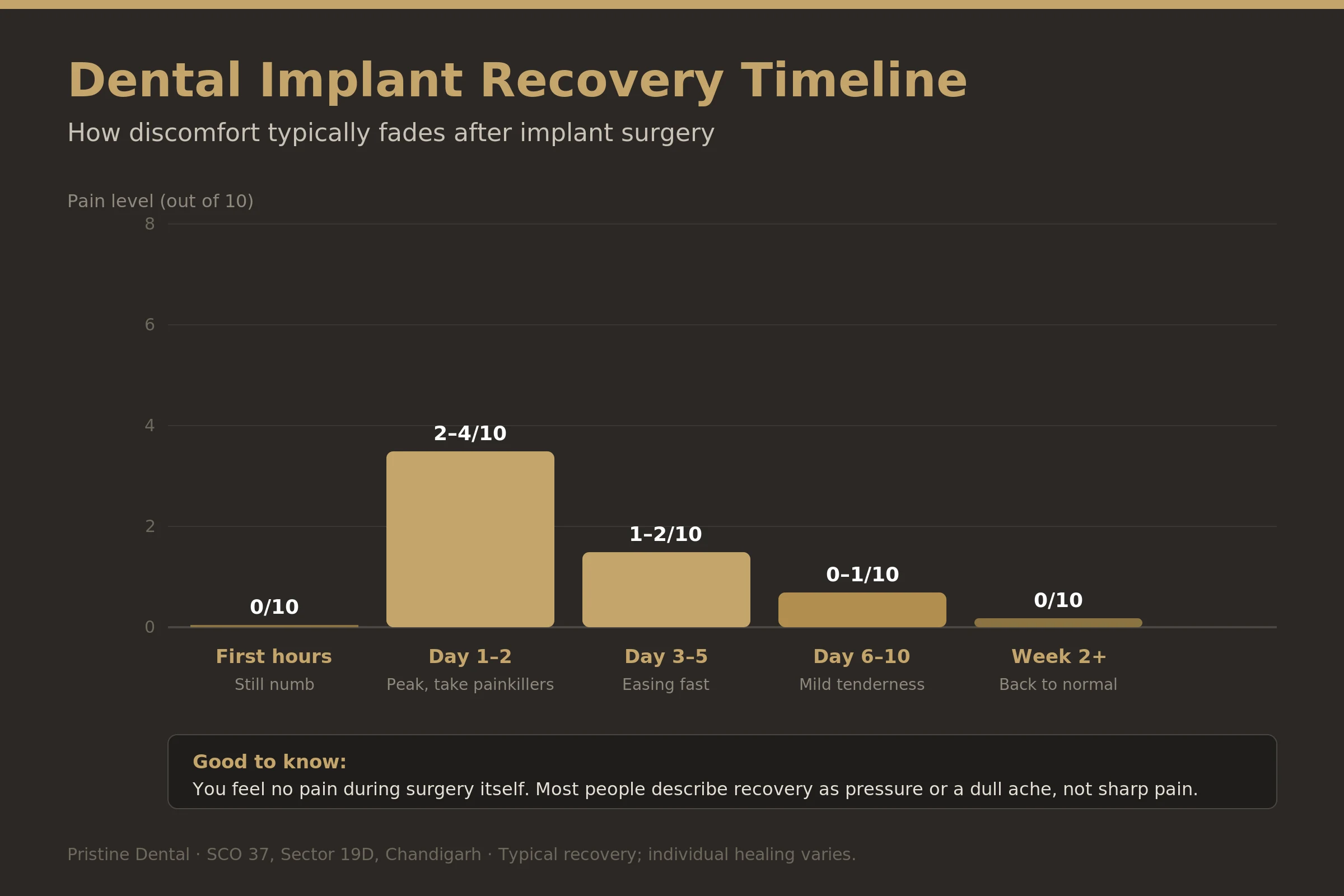
| Time After Surgery | What to Expect | Typical Pain Level |
|---|---|---|
| First few hours | Area still numb; no pain yet. Start painkillers before numbness fades. | 0 / 10 |
| Day 1–2 | Most discomfort here — throbbing, tenderness, some swelling. | 2–4 / 10 |
| Day 3–5 | Pain eases noticeably; over-the-counter painkillers usually enough. | 1–2 / 10 |
| Day 6–10 | Mild tenderness only, mainly when chewing or brushing nearby. | 0–1 / 10 |
| Week 2 onward | Soft tissue healed; you carry on normally while the bone integrates. | 0 / 10 |
Most patients describe the feeling as pressure, throbbing or tenderness rather than sharp pain, similar to the days after a tooth extraction. Everyone heals at a slightly different pace, but needing strong painkillers beyond the first day or two is uncommon.
How Does Implant Pain Compare to a Tooth Extraction?
For most people, a dental implant hurts about the same as — or less than — having a tooth pulled. That surprises many patients, but it makes sense: an extraction involves loosening and removing a tooth from its socket, while a guided implant is placed precisely into prepared bone with minimal disturbance to the surrounding tissue.
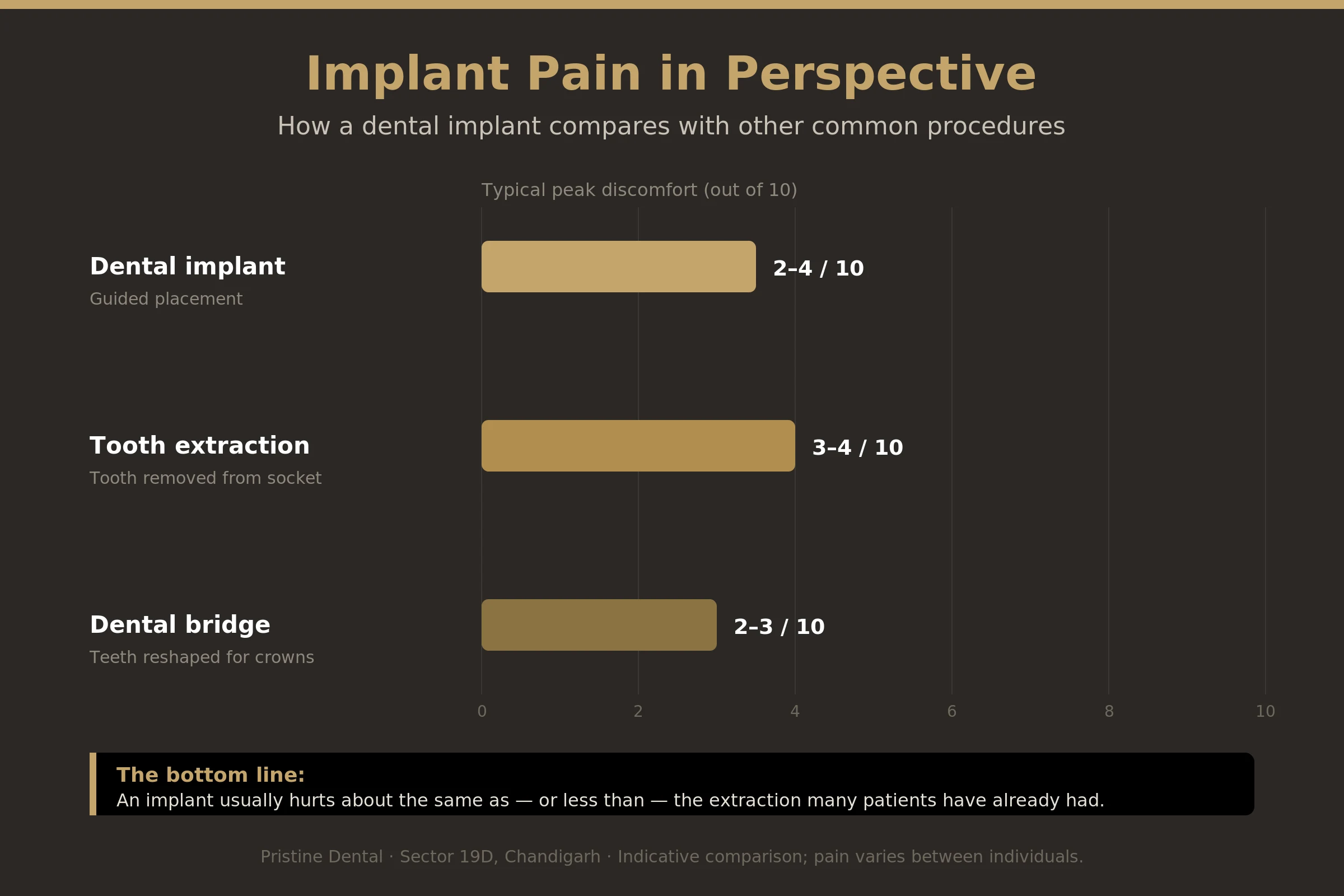
If you have already had a tooth removed — which is often why an implant is needed in the first place — you have very likely already experienced the most uncomfortable part. The implant procedure that follows is usually no worse, and modern techniques have made it more predictable and gentle than ever. It is also far gentler than many people imagine when comparing it to a fixed dental bridge, which requires reshaping the healthy teeth on either side of the gap.
What Affects How Much an Implant Hurts?
The amount of discomfort you feel depends on a handful of factors — most of which your dentist can plan around. Two patients can have very different experiences, and knowing why helps set realistic expectations.
- Number of implants placed — a single implant is very straightforward; several at once, or a full-arch case, naturally involves a bit more healing.
- Whether extra procedures are needed — a bone graft or sinus lift adds a little more swelling and recovery time.
- The condition of the site — placing an implant into a healthy, healed area is gentler than into one that was recently infected.
- Your individual pain threshold — everyone feels and reports discomfort differently, which is completely normal.
- How closely you follow aftercare — taking painkillers on time, resting, and avoiding smoking all make a real difference.
- The skill and technique of the dentist — guided, minimally invasive placement means smaller openings and an easier recovery.
This is exactly why an honest assessment beforehand matters: your dentist can tell you what to expect in your specific case rather than leaving you to worry about worst-case stories from the internet.
How to Manage and Reduce Implant Pain
The key to a comfortable recovery is staying ahead of the pain rather than chasing it. Simple aftercare keeps most patients very comfortable.
- Take painkillers on schedule — start before the numbness wears off, and take them at regular intervals for the first day, not only when it hurts.
- Use a cold compress on the cheek for the first 24 hours to reduce swelling and soothe the area.
- Eat soft, cool foods — soups, yoghurt, dal, khichdi, smoothies — and avoid hot, spicy or crunchy foods for a few days.
- Do not disturb the site: avoid touching it, and do not rinse forcefully or spit hard for the first day.
- Rinse gently with warm salt water from the day after surgery to keep the area clean.
- Avoid smoking and alcohol, which slow healing and increase discomfort and the risk of complications.
- Rest and keep your head slightly elevated for the first night to limit swelling.
Follow the specific instructions your dentist gives you — they are tailored to your case — and keep any review appointments so healing can be checked.
What's Normal and What's Not?
Mild pain, minor swelling and a little bleeding in the first days are completely normal. Severe or worsening pain after several days is not. Knowing the difference means you can relax about the normal signs and act quickly on the rare warning ones.
Normal, expected signs:
- Tenderness and throbbing for 2–5 days that steadily improves.
- Mild to moderate swelling of the gum or cheek, peaking around day 2–3.
- Slight oozing of blood on the first day.
- Mild bruising in some patients.
Call your dentist if you notice:
- Pain that gets worse after day 3–4 instead of better.
- Severe pain not relieved by painkillers.
- Heavy or ongoing bleeding, or increasing swelling after day 3.
- Fever, pus or a bad taste, which can signal infection.
- Persistent numbness or tingling that does not fade.
These issues are uncommon and usually easy to treat when caught early, so never hesitate to call your clinic.
Do Bone Grafts or Sinus Lifts Hurt More?
Additional procedures like a bone graft or sinus lift add a little more to recovery, but they are still done under anaesthesia and are well tolerated. Some patients need these when there is not enough bone to hold the implant securely. Expect a bit more swelling and a slightly longer settling period, but the pain is still typically managed with ordinary painkillers. Your dentist will tell you in advance if you need one and exactly what to expect, so there are no surprises.
Does the Crown Stage Hurt? The Rest of the Process
The implant placement is the only surgical step — attaching the final tooth afterwards is simple and virtually painless. Many patients do not realise that getting an implant usually happens in stages over a few months, and the later stages are far easier than the first.
After the implant is placed, it needs time to fuse with the bone, a natural process called osseointegration that typically takes a few months. During this period you carry on with normal life — often with a temporary tooth in place — and feel nothing from the healing implant. When it is ready, a small connector (the abutment) and your custom crown are attached. This crown stage involves no drilling into bone and usually needs only minor or no anaesthesia, so there is little to no discomfort. In other words, the part people fear most is over quickly, and everything that follows is straightforward.
Why Implants Feel Easier Than People Fear
Much of the dread around implants comes from imagination rather than experience. A few facts help put it in perspective:
- The jawbone has very few pain receptors, which is why bone work is far less painful than people expect.
- Guided, minimally invasive techniques mean smaller openings and gentler healing than older methods.
- Anaesthesia and sedation put you in complete control of your comfort.
- The result lasts for decades — a few days of mild discomfort in exchange for a permanent, natural-feeling tooth.
Why Choose Pristine Dental for Dental Implants in Chandigarh

Pristine Dental is a modern, comfort-first practice at SCO 37, First Floor, Sector 19D, Chandigarh, caring for patients across Chandigarh, Mohali, Panchkula, Zirakpur, Kharar, New Chandigarh and the wider Tricity. We understand that fear of pain holds people back, so we build our implant care around keeping you calm and comfortable at every step.
- Gentle, unhurried care — we explain everything and never rush an anxious patient.
- Effective anaesthesia and sedation options matched to how you feel.
- Guided, precise implant placement for smaller openings and easier healing.
- Clear aftercare and easy follow-up so you always know what to expect.
- Honest advice on whether you need extra procedures like a bone graft.
- Open seven days a week, convenient for the whole Tricity.
Frequently Asked Questions
Are dental implants painful?
No, not during the procedure — the area is fully numbed with local anaesthesia, so you feel only pressure, not pain. Afterwards, most patients have mild to moderate discomfort for about 3–5 days, easily controlled with ordinary painkillers.
Does the injection to numb the area hurt?
You may feel a brief pinch or sting as the anaesthetic goes in, lasting only a moment. Many dentists use a numbing gel first to make even this barely noticeable.
How long does implant pain last?
Discomfort usually peaks in the first 24–48 hours and settles within 3–5 days. Some mild tenderness when chewing or brushing near the site can linger up to about 10 days.
How bad is the pain on a scale of 1 to 10?
Most patients rate it around 2–4 out of 10 in the first couple of days — more of a dull ache or pressure than a sharp pain — and it drops quickly from there.
Does an implant hurt more than a tooth extraction?
Usually not. For most people an implant hurts about the same as, or less than, having a tooth pulled, because guided placement disturbs the surrounding tissue very little.
What painkillers will I need?
Ordinary over-the-counter painkillers such as paracetamol or ibuprofen are usually enough. Strong prescription painkillers are rarely needed beyond the first day or two.
Can I be sedated if I'm very anxious?
Yes. Alongside standard local anaesthesia, oral, inhalation or IV sedation can help very nervous patients feel deeply relaxed. Tell your dentist how anxious you feel so comfort can be matched to you.
Will I be awake during the procedure?
With local anaesthesia alone you stay awake but feel no pain. With sedation you remain conscious but deeply relaxed, and often remember little of the procedure.
How long does the surgery take?
Placing a single implant often takes just 30 to 60 minutes. More implants or additional procedures take longer, and your dentist will tell you what to expect beforehand.
Does a bone graft or sinus lift hurt more?
These add a little more swelling and a slightly longer recovery, but they are done under anaesthesia and the discomfort is still usually managed with ordinary painkillers.
When should I worry about the pain?
Call your dentist if pain worsens after day 3–4, is not relieved by painkillers, or comes with fever, pus, a bad taste, heavy bleeding or lasting numbness. These are uncommon and easily treated when caught early.
How soon can I return to work?
Many patients return to work the next day or after a day of rest, depending on the procedure and how they feel. Physically demanding activity is best avoided for a couple of days.
When to See a Dentist
If missing teeth are affecting your eating, speech or confidence, a consultation is the best first step — and it costs you nothing to ask about comfort. A dentist can assess your jawbone and gums, explain exactly what your procedure would involve, and talk through the anaesthesia and sedation options that suit you. You should also see a dentist promptly if you already have an implant and notice worsening pain, swelling or looseness, as these can be treated easily when addressed early.
Conclusion
The fear of pain keeps far too many people from replacing a missing tooth — but the reality of a dental implant is much gentler than the worry. You feel no pain during the surgery, the discomfort afterwards is mild and short-lived for most patients, and it is often no worse than a tooth extraction you may have already been through. With good anaesthesia, sedation when needed, and simple aftercare, an implant is one of the most comfortable ways to get a permanent, natural-feeling tooth. If pain has been holding you back, the honest answer is that it should not.
Nervous about implant pain? Let's talk.
Book a no-pressure consultation at Pristine Dental, SCO 37, First Floor, Sector 19D, Chandigarh. We'll assess your teeth, explain exactly what you'd feel, and go through your comfort and sedation options honestly. Serving Chandigarh, Mohali, Panchkula, Zirakpur and the wider Tricity.
Book Your Implant Consultation
Periodontist & implantologist with 14+ years' experience at Pristine Dental, Sector 19D, Chandigarh. Reviews clinical content for accuracy.