

Dental Implant vs Bridge vs Denture: How to Choose
Quick Answer
Choose a dental implant for the most natural, longest-lasting result that preserves jawbone and leaves neighbouring teeth untouched — it lasts 20+ years but costs more upfront. Choose a bridge for a faster, fixed result, especially if the teeth beside the gap already need crowns — it lasts about 10–15 years. Choose a denture to replace several or all teeth affordably, or when bone loss makes implants complex. In short: implants are the best long-term investment, bridges are a solid fixed middle option, and dentures are the most affordable and flexible.
Losing a tooth — or several — leaves you with a choice between three proven replacements: a dental implant, a fixed bridge, or a removable denture. Each works well, but they differ a lot in cost, lifespan, how they feel, and what they do to the teeth and bone around them. The "best" option is simply the one that fits your mouth, your health and your budget. This guide, written by a practising dentist, compares all three clearly so patients in Chandigarh, Mohali, Panchkula and Zirakpur can choose with confidence.
Key Takeaways
- Implants last longest (20+ years), preserve bone, and don't touch nearby teeth — highest upfront cost.
- Bridges are fixed and faster, but grind down the adjacent teeth and last 10–15 years.
- Dentures are the most affordable and can replace many teeth, but are removable and less stable.
- Only implants preserve the jawbone, because they replace the tooth root.
- Bridges suit gaps where neighbouring teeth already need crowns.
- Dentures suit multiple missing teeth or cases with significant bone loss.
What Are the Three Options?
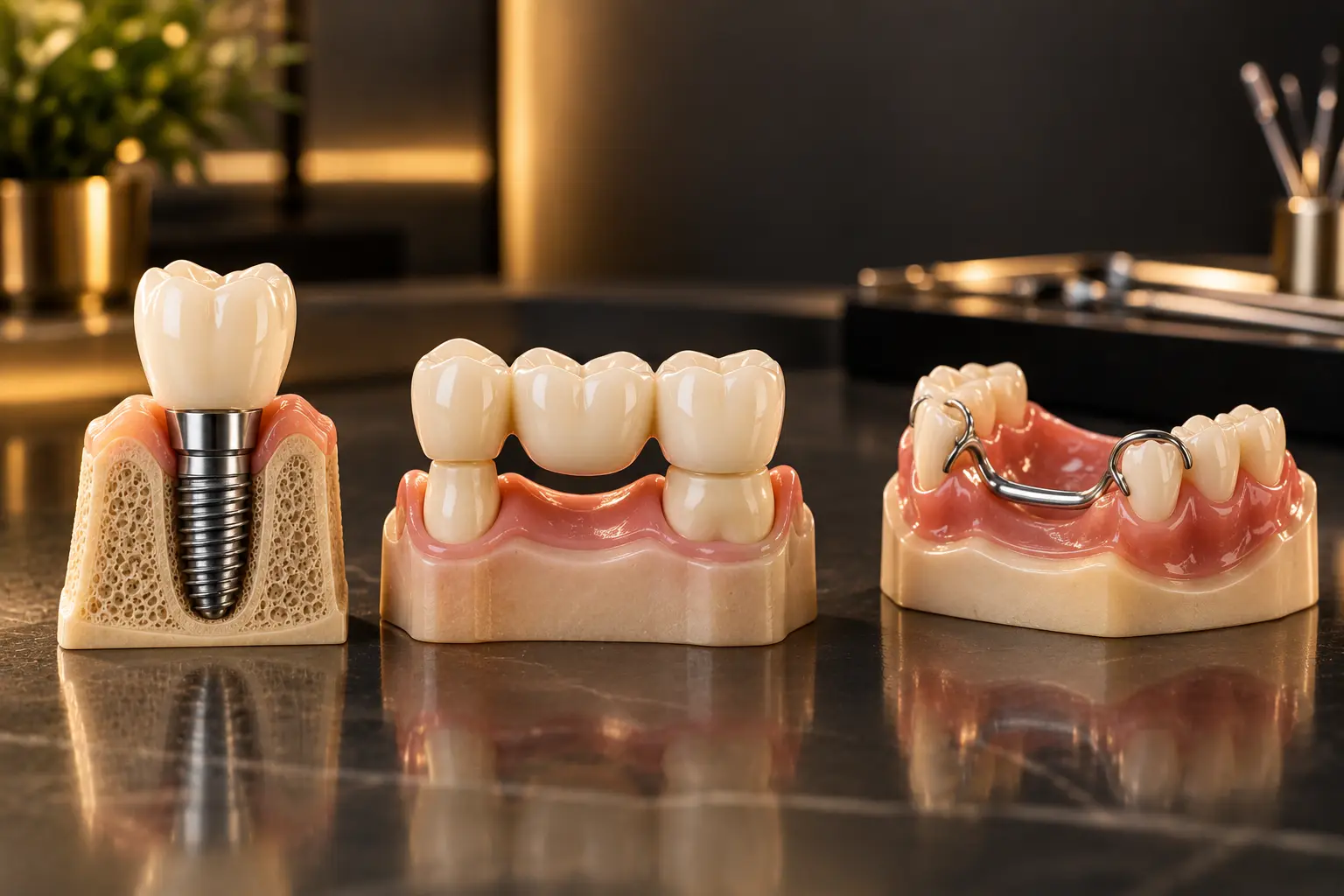
Each replaces missing teeth in a different way. Understanding how they work makes the choice much clearer.
Dental implant
A titanium post is placed in the jawbone to act as an artificial tooth root, topped with a crown. It is the only option that replaces the root, so it looks, feels and functions closest to a natural tooth. Learn more about dental implants.
Dental bridge
A fixed row of crowns that "bridges" the gap, anchored to the natural teeth on either side (which are shaped to hold it). It stays put and looks natural, but relies on those neighbouring teeth. See our crown & bridge options.
Denture
A removable appliance holding one or more false teeth, either partial (a few teeth) or complete (a full arch). It is the most affordable and can replace many teeth at once. Explore dentures in Chandigarh.
Implant vs Bridge vs Denture: Side-by-Side
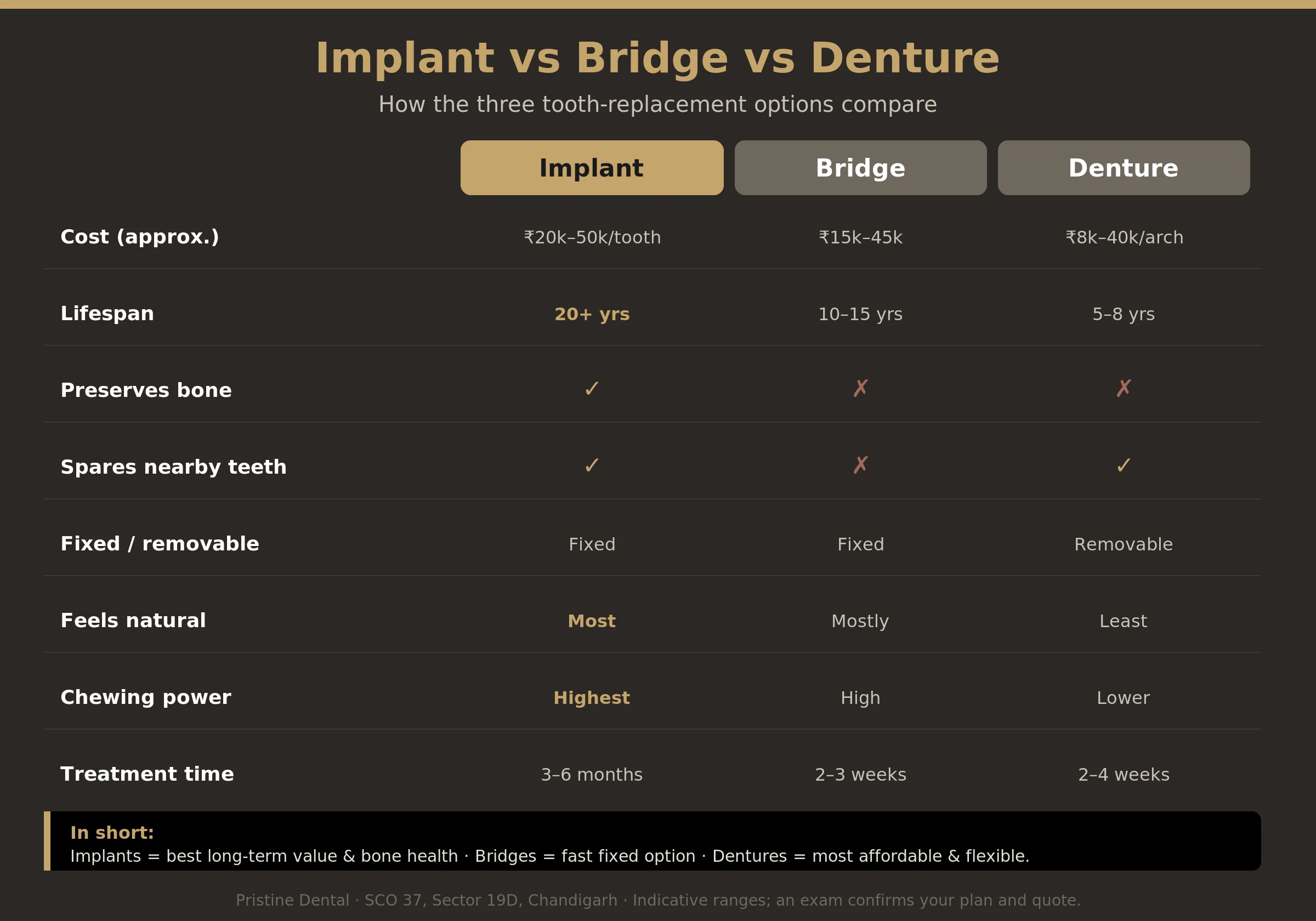
Here is how the three compare across what matters most.
| Factor | Dental Implant | Bridge | Denture |
|---|---|---|---|
| Approx. cost (Chandigarh) | ₹20,000–₹50,000 / tooth | ₹15,000–₹45,000 (3-unit) | ₹8,000–₹40,000 / arch |
| Typical lifespan | 20+ years, often lifelong | 10–15 years | 5–8 years |
| Preserves jawbone | Yes | No | No |
| Affects nearby teeth | No | Yes (grinds them) | No |
| Fixed or removable | Fixed | Fixed | Removable |
| Feels like natural teeth | Most | Mostly | Least |
| Treatment time | 3–6 months | 2–3 weeks | 2–4 weeks |
| Chewing power | Highest | High | Lower |
These are typical ranges for the Tricity, not a fixed quote — the final cost depends on the materials, number of teeth and your specific case. For a full breakdown, see our guide to dental treatment costs and book an examination for an accurate figure.
Cost: Upfront Price vs Long-Term Value
Dentures are cheapest upfront, implants cost the most — but over 20–30 years, implants are often the best value. A bridge or denture usually needs redoing every 7–15 years, so the cost of repeated replacements can quietly exceed a one-time implant that lasts a lifetime. Dentures make sense when budget is the priority or many teeth are missing; bridges offer a middle ground; implants are the long-term investment. India also remains far more affordable than Western countries for all three.
Bone Health: The Hidden Difference
Only a dental implant preserves the jawbone, because it replaces the tooth root and keeps the bone stimulated. When a tooth is lost, the bone that held it gradually shrinks. Bridges and dentures sit on top of the gum and do nothing to stop this, so over the years the jaw can lose height and the face can take on a "sunken" look. Denture wearers, in particular, can lose bone steadily, which is why dentures need periodic relining. If protecting your long-term facial structure matters to you, this is the single biggest reason many dentists favour implants where possible.
Which Should You Choose?
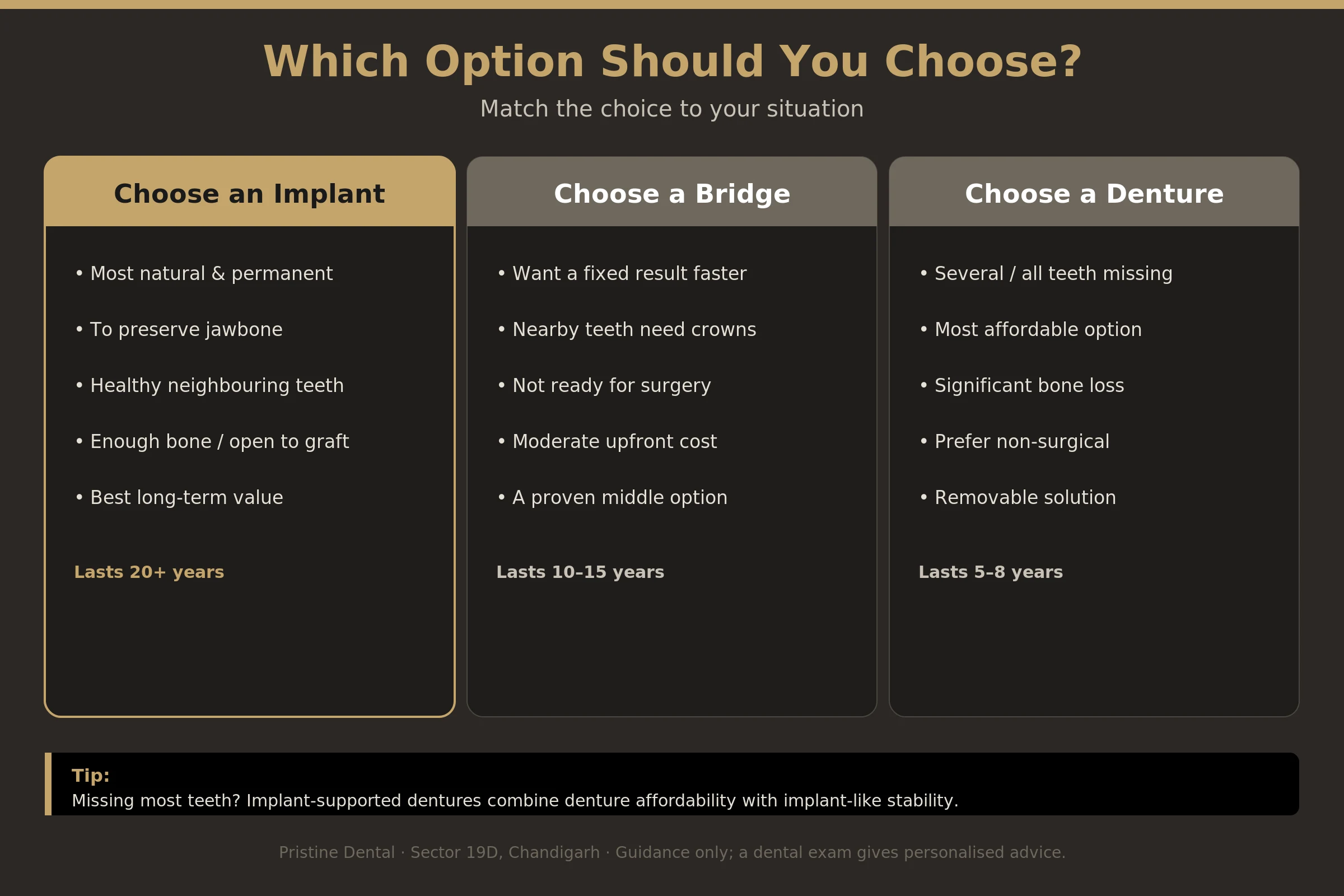
A dental implant may be best if you:
- Want the most natural, permanent and low-maintenance result.
- Want to preserve your jawbone and facial structure.
- Have healthy neighbouring teeth you don't want to grind down.
- Have enough bone (or are open to a graft) and good general health.
- Value long-term cost-effectiveness over the lowest upfront price.
A bridge may be best if you:
- Want a fixed result faster, in a few weeks rather than months.
- Have adjacent teeth that already need crowns or large fillings.
- Are not a candidate for implant surgery right now.
- Prefer a moderate upfront cost between dentures and implants.
A denture may be best if you:
- Are missing several or all teeth in an arch.
- Want the most affordable option.
- Have significant bone loss that makes implants complex.
- Prefer a non-surgical, removable solution.
You don't have to choose alone — or choose just one
Options can be combined: implant-supported dentures clip onto a couple of implants for far more stability, giving denture affordability with implant-like security. The right plan depends on your mouth, which is what a consultation is for.
What About Implant-Supported Dentures?
If you are missing most or all of your teeth, implant-supported dentures offer a middle path — the stability of implants at a lower cost than a full set of individual implants. A small number of implants (often two to four per arch) hold a denture firmly in place, so it does not slip while eating or speaking, and it helps slow bone loss. It costs more than a conventional denture but far less than replacing every tooth with its own implant, making it a popular, life-changing choice for long-term denture wearers.
What Happens If You Leave the Gap?
Choosing to do nothing is also a decision — and it rarely stays harmless for long. When a missing tooth is left unreplaced, a chain of changes tends to follow over months and years:
- The jawbone shrinks where the tooth used to be, making future treatment more complex.
- Neighbouring teeth drift into the gap, throwing off your bite and making cleaning harder.
- The opposing tooth over-erupts because it has nothing to bite against.
- Chewing shifts to one side, which can strain the jaw joint and wear other teeth.
- Speech and confidence can suffer, especially with front teeth.
This is why acting sooner usually keeps more options open and costs less overall — whichever replacement you eventually choose.
Caring for Your Tooth Replacement
Whichever option you choose, good daily care and regular check-ups make it last. The routine is simple and not very different from looking after natural teeth:
- Implants — brush and clean around them daily (including interdental brushes), and keep professional cleanings; they can't decay but the surrounding gum and bone still need protecting.
- Bridges — clean under the bridge with floss threaders or a water flosser, since food can collect beneath it.
- Dentures — remove and clean them daily, rest your gums overnight, and have them relined as the bone changes.
- Everyone — avoid biting very hard objects, limit staining and tobacco, and attend regular reviews so small issues are caught early.
Why Choose Pristine Dental in Chandigarh

Pristine Dental is a modern, ethics-first practice at SCO 37, First Floor, Sector 19D, Chandigarh, caring for patients across Chandigarh, Mohali, Panchkula, Zirakpur, Kharar, New Chandigarh and the wider Tricity. We help you weigh all three teeth-replacement options honestly — never pushing the most expensive one.
- A proper assessment first — bone, gums, bite and the teeth beside the gap.
- All three options offered, with the real pros and cons for your case.
- 3D-guided implant planning for precise, predictable results.
- Transparent, itemised pricing so you can compare clearly.
- Open seven days a week, convenient for the whole Tricity.
Frequently Asked Questions
Which is better: implant, bridge or denture?
It depends on your case. Implants last longest and preserve bone but cost more; bridges are fixed and faster, especially if neighbouring teeth need crowns; dentures are the most affordable and best for multiple missing teeth. A dentist recommends the right fit after an exam.
Which option lasts the longest?
Dental implants last the longest — often 20 years or more, sometimes a lifetime. Bridges last about 10–15 years and dentures around 5–8 years before they need replacing or relining.
Which is the cheapest way to replace a tooth?
Dentures are cheapest upfront, followed by bridges, with implants costing the most initially. However, because implants last so much longer, they are often the most cost-effective over 20–30 years.
Do bridges and dentures preserve the jawbone?
No. Only implants preserve the jawbone, because they replace the tooth root and keep the bone stimulated. Bridges and dentures sit on top of the gum and do not prevent the bone loss that follows tooth loss.
Does a bridge damage healthy teeth?
A traditional bridge requires the teeth on either side of the gap to be shaped down to hold the crowns, which is permanent. If those teeth are healthy, an implant may be preferable because it leaves them untouched.
Can I get implants if I've worn dentures for years?
Often yes, though long-term denture use can cause bone loss that may require a graft first. A scan shows whether you have enough bone, or whether implant-supported dentures are a good option.
What are implant-supported dentures?
They are dentures that clip onto a few implants for much greater stability. They cost more than a standard denture but less than replacing every tooth with its own implant, and they help slow bone loss.
Which option looks the most natural?
Implants generally look and feel the most natural because they replace the whole tooth including the root. Well-made bridges also look very natural, while dentures are the least natural-feeling of the three.
How long does each treatment take?
A bridge or denture usually takes a few weeks. An implant takes longer — typically 3–6 months — because the implant must fuse with the bone before the final tooth is fitted.
Can I switch from one option to another later?
Yes. Many people start with a denture or bridge and move to implants later, or upgrade a loose denture to an implant-supported one. A dentist can plan a path that suits your budget over time.
How do I decide which is right for me?
A consultation is the best way. Your dentist examines your bone, gums, bite and the teeth around the gap, discusses your goals and budget, and gives you an honest recommendation with an itemised cost for each option.
When to See a Dentist
If you have a missing tooth, a failing bridge, or a loose denture, see a dentist sooner rather than later — the longer a gap is left, the more bone is lost and the more complex treatment becomes. A dentist will assess your mouth, explain which of the three options suit you, and give you a clear, itemised plan for each. Book a consultation to find the right tooth replacement for your smile and budget.
Conclusion
There is no single best way to replace a missing tooth — only the best option for you. Implants are the gold standard for longevity, bone preservation and natural function, and are usually the best long-term value. Bridges are a strong fixed choice when neighbouring teeth already need work or when you want a faster result. Dentures remain the most affordable and flexible way to replace several or all teeth. The right decision comes from an honest examination and a clear conversation about your goals and budget — so you replace your tooth once, and replace it well.
Not sure which tooth replacement is right for you?
Book a consultation at Pristine Dental, SCO 37, First Floor, Sector 19D, Chandigarh. We'll assess your mouth, explain all three options honestly, and give you an itemised plan — with no pressure. Serving Chandigarh, Mohali, Panchkula, Zirakpur and the wider Tricity.
Book Your Consultation
Periodontist & implantologist with 14+ years' experience at Pristine Dental, Sector 19D, Chandigarh. Reviews clinical content for accuracy.