

Porcelain vs Composite Veneers: Which Should You Choose?
Quick Answer
Choose composite veneers if you want a lower cost, a single-visit result, minimal or no enamel removal, and an easily repairable, near-reversible option — they last around 4–8 years. Choose porcelain veneers if you want the most natural look, the best stain resistance and the longest-lasting result — 10–15+ years — and are comfortable with a small, permanent amount of enamel reduction. For a full, uniform smile makeover, porcelain is usually the better long-term choice; for small fixes or a tight budget, composite makes great sense.
Once you have decided you want veneers, the next question is almost always the same: porcelain or composite? Both can give you a brighter, straighter-looking smile, but they differ in cost, longevity, appearance and how much of your natural tooth they involve. There is no single "best" — only the best choice for your teeth, your goals and your budget. This guide, written by a practising dentist, compares them honestly, factor by factor, so patients in Chandigarh, Mohali, Panchkula and Zirakpur can decide with confidence.
Key Takeaways
- Composite is cheaper, done in one visit, easily repaired, and needs little or no enamel removal.
- Porcelain looks the most natural, resists stains best, and lasts far longer.
- Lifespan: composite 4–8 years vs porcelain 10–15+ years.
- Reversibility: composite is largely reversible; porcelain usually involves permanent enamel reduction.
- Best for a full makeover: porcelain, for a uniform, lasting result.
- Best for small fixes or budgets: composite, and it can "test" a change before porcelain.
What Are Porcelain and Composite Veneers?
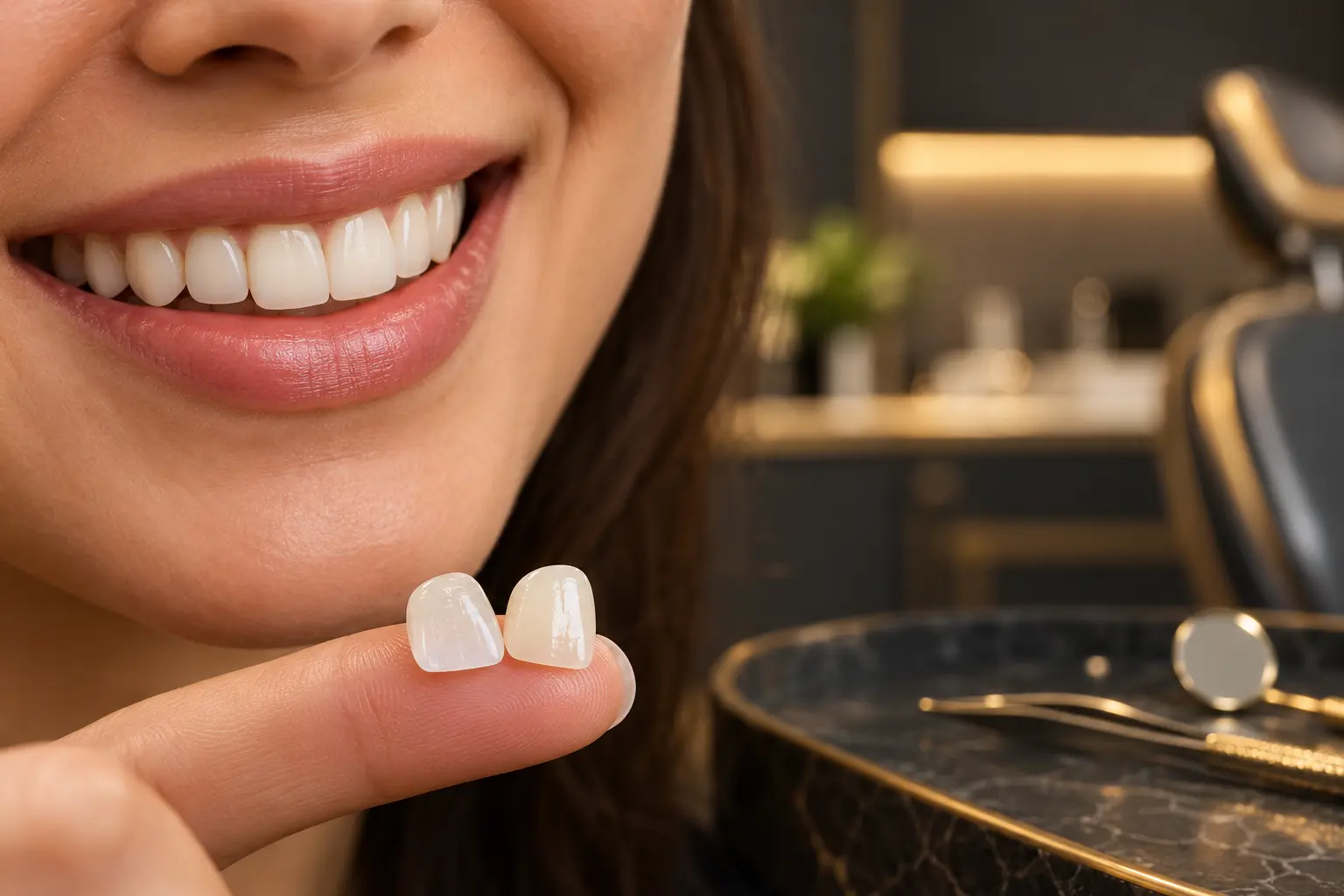
Both are thin coverings bonded to the front of your teeth to improve their colour, shape and alignment — the difference is the material and how they are made.
Composite veneers
Made from tooth-coloured resin that the dentist sculpts and bonds directly onto your teeth, usually in a single appointment. Because the work is done in your mouth, little or no enamel needs to be removed.
Porcelain veneers
Thin, custom ceramic shells made in a dental lab from impressions of your teeth, then bonded on over two or three visits. A small amount of enamel is usually removed so they sit flush and natural. Both are excellent options — explore our veneers and laminates to see what suits you, or read the American Dental Association's patient guide to veneers.
Porcelain vs Composite: Side-by-Side Comparison
Here is how the two materials compare across the factors that matter most, in line with published research comparing ceramic and composite veneers.
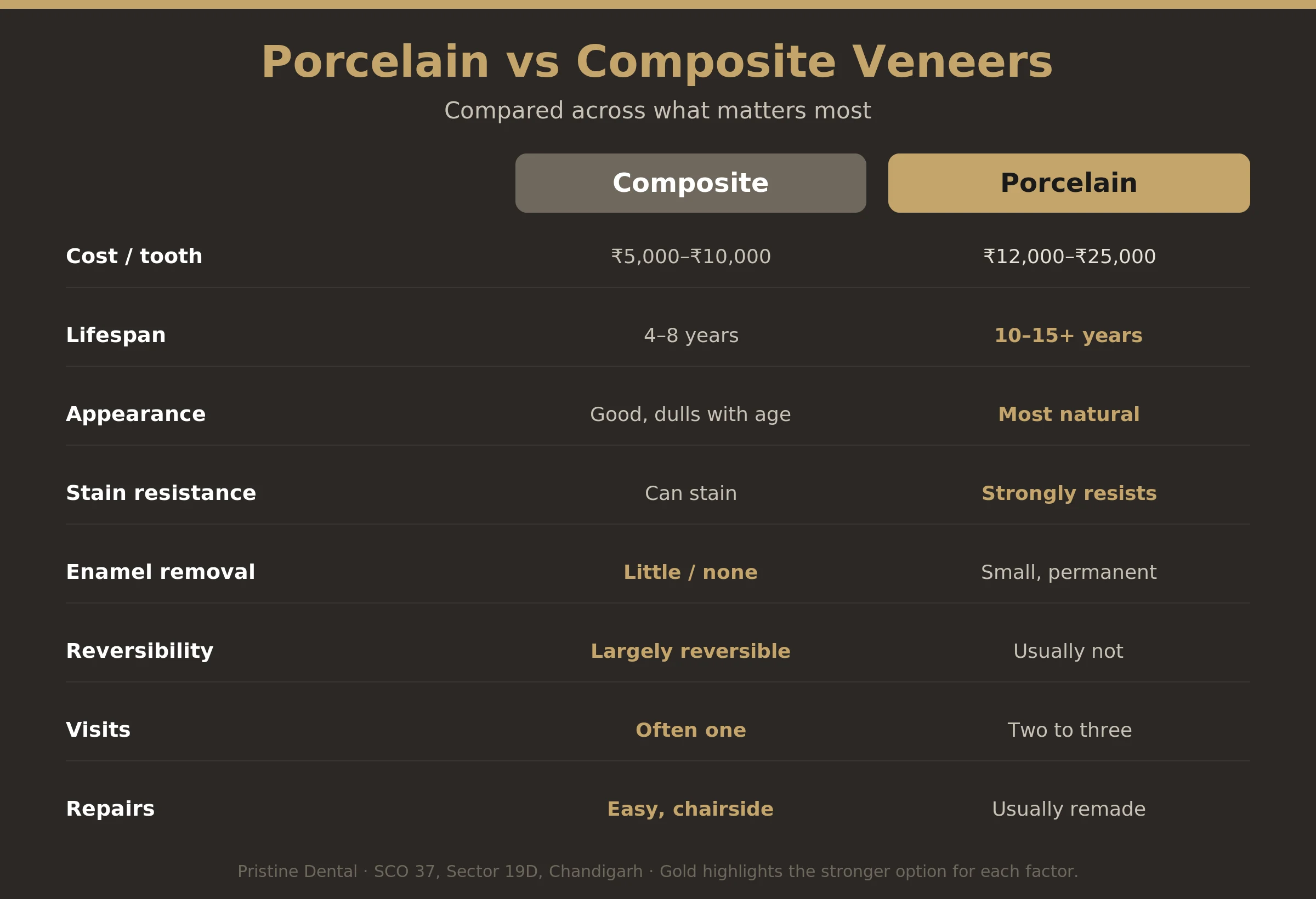
| Factor | Composite Veneers | Porcelain Veneers |
|---|---|---|
| Cost per tooth (Chandigarh) | ₹5,000 – ₹10,000 | ₹12,000 – ₹25,000 |
| Lifespan | 4–8 years | 10–15+ years |
| Appearance | Very good; can look flatter, dulls with age | Most natural; translucent like real enamel |
| Stain resistance | Can stain over time | Strongly resists stains |
| Enamel removal | Little or none | Small, permanent amount |
| Reversibility | Largely reversible | Usually not reversible |
| Number of visits | Often one visit | Two to three visits |
| Repairs | Easy, chairside, low cost | Usually needs remaking |
Cost: Composite Wins Upfront, Porcelain on Value
Composite veneers cost less to begin with, but porcelain often works out similar or cheaper per year because it lasts so much longer. In Chandigarh, composite runs about ₹5,000–₹10,000 per tooth and porcelain about ₹12,000–₹25,000. Spread over their lifespans, porcelain at ₹18,000 lasting 15 years is roughly ₹1,200 a year, while composite at ₹8,000 lasting 5 years is about ₹1,600 a year. If budget is your immediate concern, composite is friendlier; if long-term value matters most, porcelain usually wins. For a full breakdown, see our guide to dental veneer costs in Chandigarh.
Appearance: Which Looks More Natural?
Porcelain has the edge on realism. Its ceramic mimics the way light passes through natural enamel, giving a translucent, lifelike glow that is very hard to distinguish from real teeth. Composite looks good too, especially for small changes, but it is slightly more opaque, can appear a little flatter, and tends to lose its shine over the years. For front teeth that catch the light — and for a full smile where every tooth must match — porcelain generally gives the most polished result.
Durability and Stain Resistance
Porcelain is stronger, lasts longer and resists staining far better than composite. Porcelain veneers commonly last 10–15 years or more and shrug off stains from tea, coffee, wine and turmeric, a longevity supported by long-term clinical studies. Composite is softer, wears down faster, and is more porous, so it can pick up stains and need polishing or replacement sooner — typically every 4–8 years. If you drink a lot of chai or coffee, or you want a result you rarely have to think about, porcelain is the safer bet.
Tooth Preservation and Reversibility
This is where composite has a real advantage. Composite veneers usually need little or no enamel removed, which keeps more of your natural tooth and makes them largely reversible — a big plus if you are unsure or want to try a change first. Porcelain veneers normally require a small, permanent amount of enamel reduction (about 0.3–0.7 mm), which means the tooth will always need some form of covering afterwards. Neither is "bad," but if preserving natural tooth structure is a priority for you, composite is the more conservative choice.
Treatment Time and Repairs
Composite is faster to place and easier to fix; porcelain takes longer but is more robust. Composite veneers are often completed in a single visit, and if one chips, a dentist can usually add and re-cure fresh resin chairside in one short appointment. Porcelain takes two or three visits because the shells are lab-made, and a damaged porcelain veneer generally has to be remade rather than patched. So composite suits people who want a quick result and simple repairs, while porcelain suits those happy to invest a little more time for a longer-lasting outcome.
Which Should You Choose? A Simple Guide
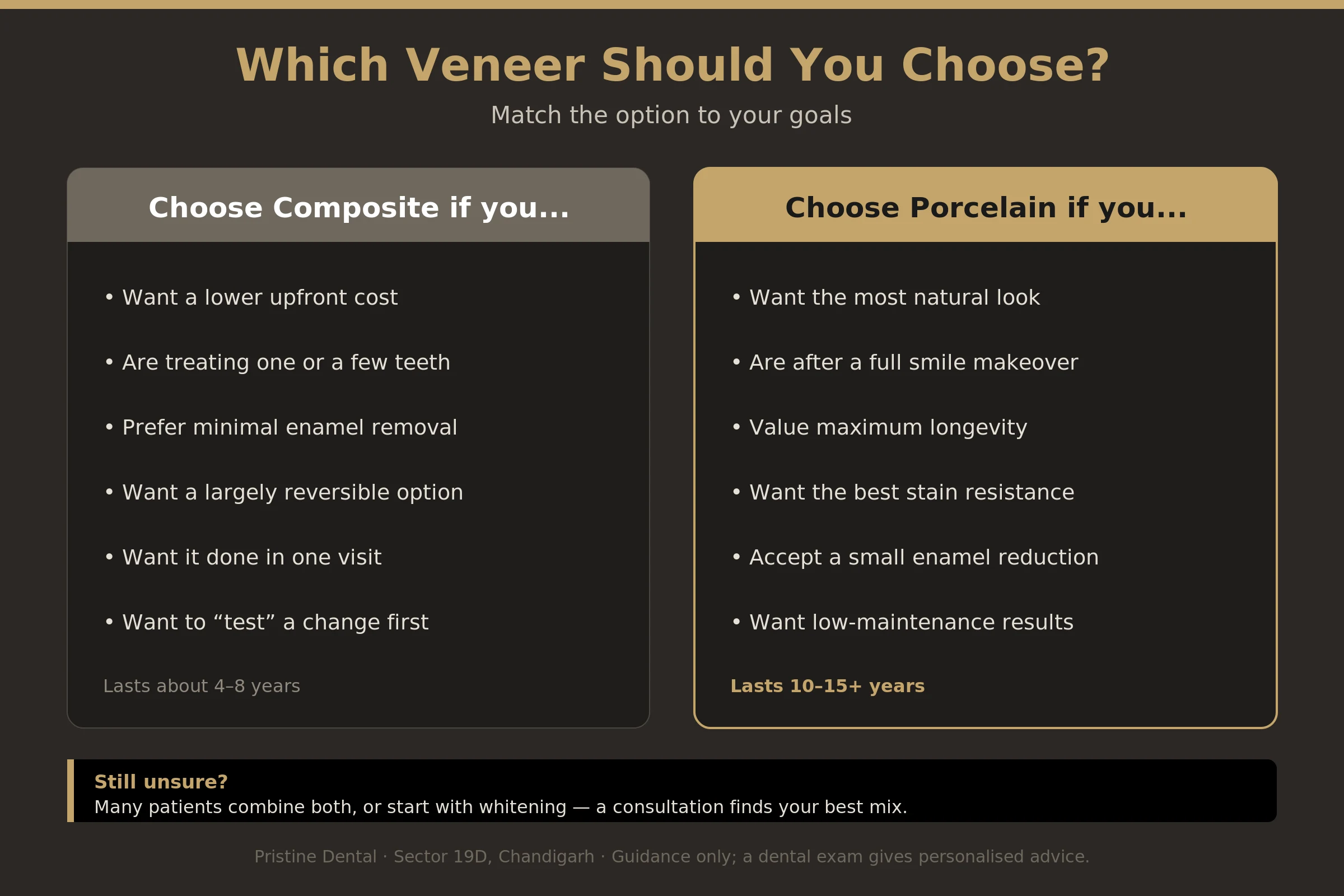
Composite may be right for you if you:
- Want a lower upfront cost or are on a budget.
- Are treating one or a few teeth, or a small chip or gap.
- Prefer minimal enamel removal and a largely reversible option.
- Want your result in a single visit.
- Would like to "test" a change before committing to porcelain.
Porcelain may be right for you if you:
- Want the most natural, translucent appearance.
- Are after a full, uniform smile makeover across the smile zone.
- Value maximum longevity and stain resistance.
- Are comfortable with a small, permanent enamel reduction.
- Prefer a result you rarely have to maintain.
Not sure? You do not have to choose alone
Many patients combine approaches — composite on a couple of teeth, porcelain across the smile line, or whitening first. The right mix depends on your teeth, your goals and your budget, which is exactly what a consultation is for.
Are There Alternatives to Veneers?
Sometimes the best answer is not a veneer at all. If your only concern is colour, teeth whitening can brighten your smile at a fraction of the cost. If your teeth are noticeably crooked or crowded, clear aligners or braces may be a better first step than covering them. And for a complete transformation, a planned smile makeover can combine several treatments. An honest cosmetic dentist will tell you when a simpler or different option would serve you better.
How to Make Either Veneer Last Longer
Whichever material you choose, good habits protect your investment and keep your smile looking its best. Veneers are durable, but they are not indestructible — a little care goes a long way.
- Brush twice daily and floss to keep the gum line and veneer edges healthy.
- Avoid biting hard objects — ice, pens, nails or opening packaging — which can chip any veneer.
- Wear a night guard if you grind or clench, as grinding is a leading cause of veneer damage.
- Limit staining habits — tea, coffee, red wine and tobacco — especially with composite.
- Keep regular check-ups and cleanings so small issues are caught and polished early.
With this simple routine, composite veneers comfortably reach the top of their 4–8 year range and porcelain often lasts well beyond 15 years.
Common Myths About Veneers
- "Veneers always look fake." Well-made veneers — especially porcelain — are matched to your face and are very hard to tell from natural teeth.
- "Veneers ruin your teeth." Composite needs little or no enamel removed; porcelain needs only a thin, careful reduction. Healthy teeth are not "ruined."
- "You must do all your teeth." Many people veneer just one, two or a few teeth — you treat only what shows and needs it.
- "Veneers are only about looks." They also restore chipped and worn front teeth, improving function and confidence.
- "Cheaper is just as good." Material quality and the dentist's skill strongly affect how natural and long-lasting the result is.
Why Choose Pristine Dental for Veneers in Chandigarh

Pristine Dental is a modern, ethics-first practice at SCO 37, First Floor, Sector 19D, Chandigarh, caring for patients across Chandigarh, Mohali, Panchkula, Zirakpur, Kharar, New Chandigarh and the wider Tricity. We help you choose between porcelain and composite based on your face, goals and budget — never a one-size-fits-all answer.
- Honest guidance on which material — or combination — suits you.
- Quality porcelain, E-max and composite options, explained clearly.
- Digital smile planning so you can preview your result first.
- Tooth-preserving approach — we remove only what is necessary.
- Transparent pricing and open seven days a week for the whole Tricity.
Frequently Asked Questions
Which is better, porcelain or composite veneers?
Neither is universally better. Porcelain looks the most natural, resists stains and lasts 10–15+ years, while composite is cheaper, done in one visit, easily repaired and largely reversible. The best choice depends on your goals, budget and how many teeth you are treating.
Which lasts longer, porcelain or composite?
Porcelain lasts much longer — typically 10–15 years or more, versus around 4–8 years for composite. Porcelain also keeps its appearance better over time.
Which is cheaper?
Composite is cheaper upfront, around ₹5,000–₹10,000 per tooth versus ₹12,000–₹25,000 for porcelain in Chandigarh. Because porcelain lasts longer, its cost per year is often similar or lower.
Which looks more natural?
Porcelain generally looks more natural because it is translucent and reflects light like real enamel. Composite looks good, especially for small changes, but can appear slightly flatter and dulls a little with age.
Do both types require enamel removal?
Porcelain usually needs a small, permanent amount of enamel removed (about 0.3–0.7 mm). Composite often needs little or no removal, which makes it more conservative and largely reversible.
Are composite veneers reversible?
Largely, yes. Because little or no enamel is removed, composite veneers can often be removed without significant damage to the tooth. Porcelain veneers are generally not reversible once enamel has been reduced.
Which is easier to repair?
Composite. If it chips, a dentist can usually add and cure fresh resin chairside in one short visit. A damaged porcelain veneer typically has to be remade in a lab.
Can I switch from composite to porcelain later?
Yes. Many people start with composite and upgrade to porcelain later. Composite is a good way to test a change before committing to the longer-lasting porcelain option.
Which is better for a full smile makeover?
Porcelain is usually preferred for a full makeover because it gives a uniform, natural and long-lasting result across all the teeth that show when you smile.
Do veneers stain like natural teeth?
Porcelain strongly resists staining. Composite is more porous and can pick up stains from tea, coffee, wine and coloured foods over the years, which is one reason porcelain lasts better cosmetically.
How do I know which is right for me?
A cosmetic consultation is the best way. Your dentist assesses your teeth, gums, bite and goals, and recommends porcelain, composite or a combination — along with an honest, itemised cost.
Do both need special care?
No special products are essential for either. Brush and floss normally, avoid biting very hard objects, limit staining habits, wear a night guard if you grind, and keep regular check-ups.
When to See a Dentist
If you are weighing porcelain against composite, a cosmetic consultation is the best next step — and the only way to get advice tailored to your teeth. A dentist will examine your teeth, gums and bite, discuss your goals and budget, and show you the realistic result of each option, often with digital smile planning. Book a consultation to see which veneer — or combination — is right for your smile.
Conclusion
Porcelain and composite veneers are both excellent ways to transform a smile — the right one simply depends on what you value most. Composite wins on upfront cost, speed, tooth preservation and easy repairs, making it ideal for small fixes and tighter budgets. Porcelain wins on natural appearance, stain resistance and longevity, making it the go-to for a full, lasting smile makeover. The best decision always comes from an honest examination and a clear conversation about your goals — not a price list. Choose the option that fits your life, and your smile will thank you for years to come.
Still deciding between porcelain and composite?
Book a cosmetic consultation at Pristine Dental, SCO 37, First Floor, Sector 19D, Chandigarh. We'll assess your teeth, preview your options, and recommend the honest best fit — with no pressure. Serving Chandigarh, Mohali, Panchkula, Zirakpur and the wider Tricity.
Book Your Veneers Consultation
Periodontist & implantologist with 14+ years' experience at Pristine Dental, Sector 19D, Chandigarh. Reviews clinical content for accuracy.